
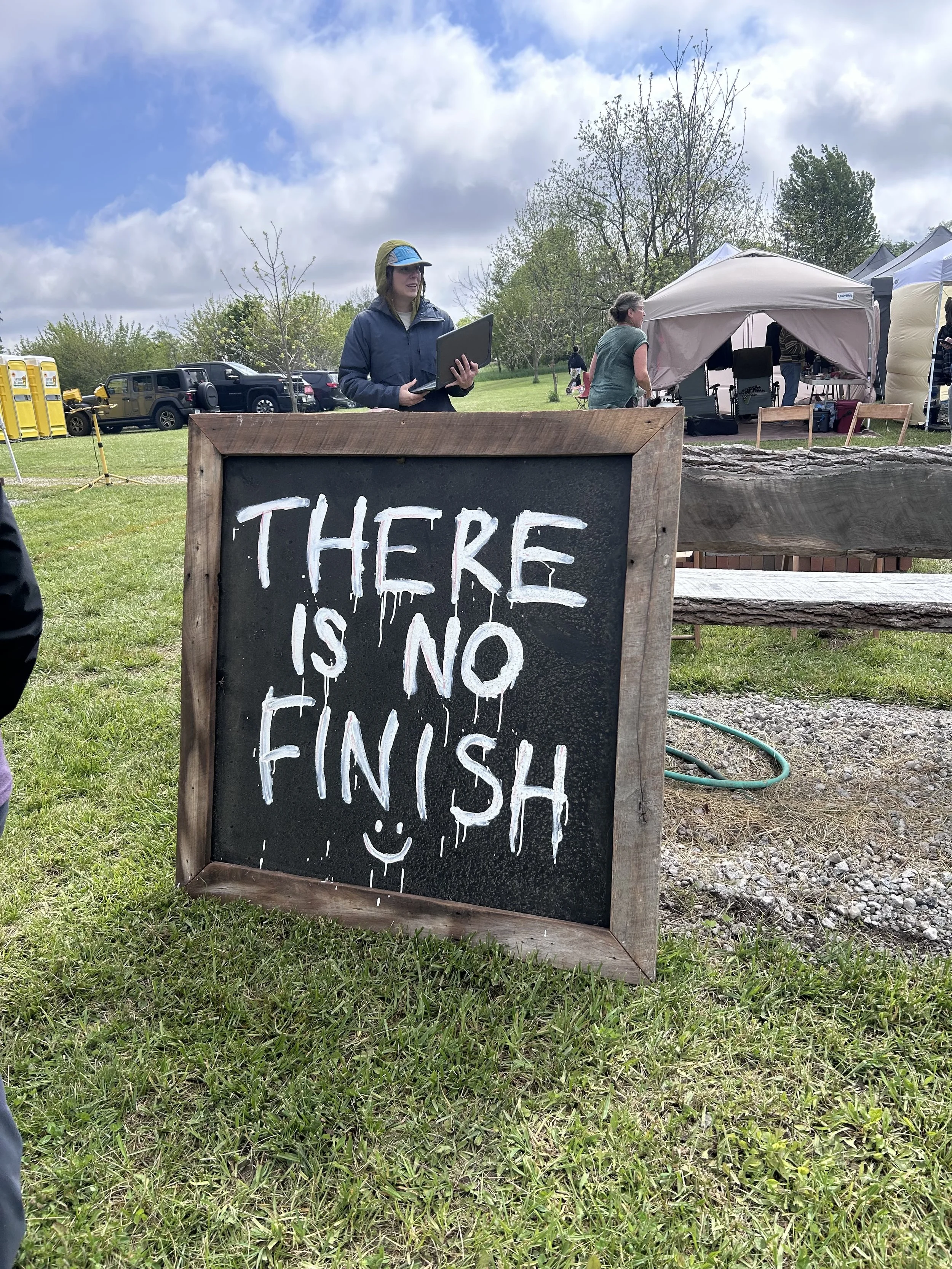
Finding Out What Is Possible in a Backyard Ultra
When you stand beside the same runners every single hour, sharing the same exhaustion, uncertainty, pain, weather, darkness, and tiny victories for an entire day and night, something shifts. You stop racing against strangers and start surviving alongside them. Everyone out there is fighting some version of themselves.
Six years after first experiencing the backyard ultra format during the pandemic, I finally stood on the starting line of a true live backyard ultra, and it turned into one of the most meaningful race experiences I’ve ever had.
Back in 2020, I ran the Quarantine Backyard Ultra out of my home alongside thousands of runners around the world. Everyone checked in after each 4.167-mile loop from their computers as we all tried to stay connected during the height of COVID. At the time, all the races I had trained for were canceled, group runs disappeared overnight, and the running community suddenly felt very far away.
Instead of letting the training go to waste, I turned the event into a fundraiser for our local United Way COVID relief fund. I checked in after every loop on Facebook Live, entertained my running friends throughout the day, and somehow convinced people to donate while watching me slowly unravel lap after lap in my neighborhood. We ended up raising $1,214.00 and I ran 17 yards (70.839 miles). Looking back, it was one of the purest reminders of what running communities can do for each other when things get hard.
That virtual event was my introduction to the backyard ultra format.

All packed for Grind…“Bib” sticker on tote Tim printed me for the Quarantine Backyard Ultra.
For anyone unfamiliar, the backyard ultra was created by Gary Cantrell, better known as Lazarus Lake, the same mind behind the infamous Barkley Marathons. The concept is brilliantly simple and absolutely ruthless.
Runners complete one “yard,” which is exactly 4.167 miles (6.706 kilometers), every hour on the hour. That specific distance matters because if you complete one yard every hour for 24 hours, you end up with exactly 100 miles. Finish the loop in under an hour, and whatever time you have left becomes your recovery time before the next start. Finish too late, or fail to make it back into the starting corral for the next hour, and you’re out.
Then everyone does it again.
And again.
Until only one runner remains.
There are no set finish distances. No guaranteed finish times. No hiding in the middle of the pack. The race keeps going until there is one last person capable of completing another yard alone.

That final successful loop is called “The Assist” for the second-place runner, because their final completed yard enables the winner to continue one more loop and officially become the Last Person Standing.
It sounds manageable at first because the pace requirement averages out to roughly a 14:24 mile pace if you move continuously. But the challenge is everything else that happens inside that hour: eating, hydrating, changing clothes, bathroom breaks, stretching, shoe swaps, weather adjustments, mental resets, and eventually even trying to squeeze in tiny naps. Backyard ultras aren’t really about speed. They’re about problem solving, patience, and slowly surviving your own decisions longer than everyone else.
I’m not new to looped courses. Over the years I’ve done well at the Hawthorn Half Day Relay and Ultra in the 12 hour solo division (shameless plug since I now own the race), which uses a 3.1 mile loop format. That race is time based rather than elimination based, but I’ve learned something important about myself through those events: I actually like loops.
I think it’s because every loop becomes its own manageable task. Run a solid loop. Earn a quick reset. Grab a reward. See your people. Repeat.
There’s also something motivating about constantly seeing other runners instead of disappearing alone into the woods for hours (which I love equally). Backyard ultras especially create this weird little moving community where everyone is simultaneously competing against and supporting each other all day long.
Another advantage of the format is access to your own aid station every single hour. In many ultras you’re relying mostly on aid stations and carefully planned drop bags. In a backyard ultra, your entire race headquarters is sitting right there waiting for you every loop. That means you can constantly adjust, and those adjustments are often what determine how long you stay alive in the race.
This year I decided I wanted to experience a true backyard ultra in person, and I signed up for Grind on the Grid Backyard Ultra.
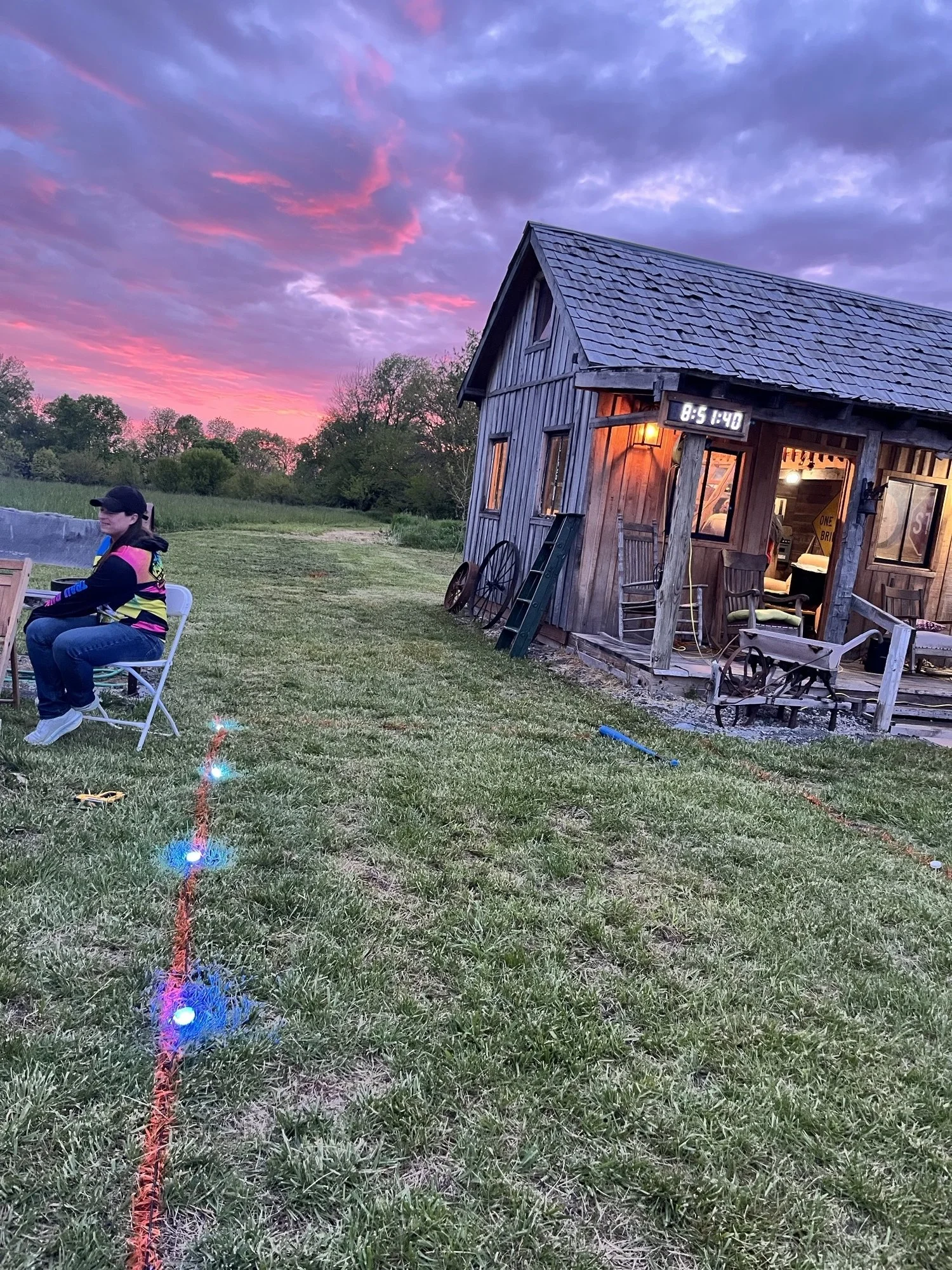

I’d always wanted this race to be my first real backyard. It’s a little over an hour from home, intentionally small, and put on by people who genuinely care about the experience. Small ultras are getting harder and harder to find as the sport grows, and this one still had that grassroots feel I love.
Also, the race director's mom makes a handmade quilt for the Last Person Standing.
And honestly?
I really wanted the quilt.
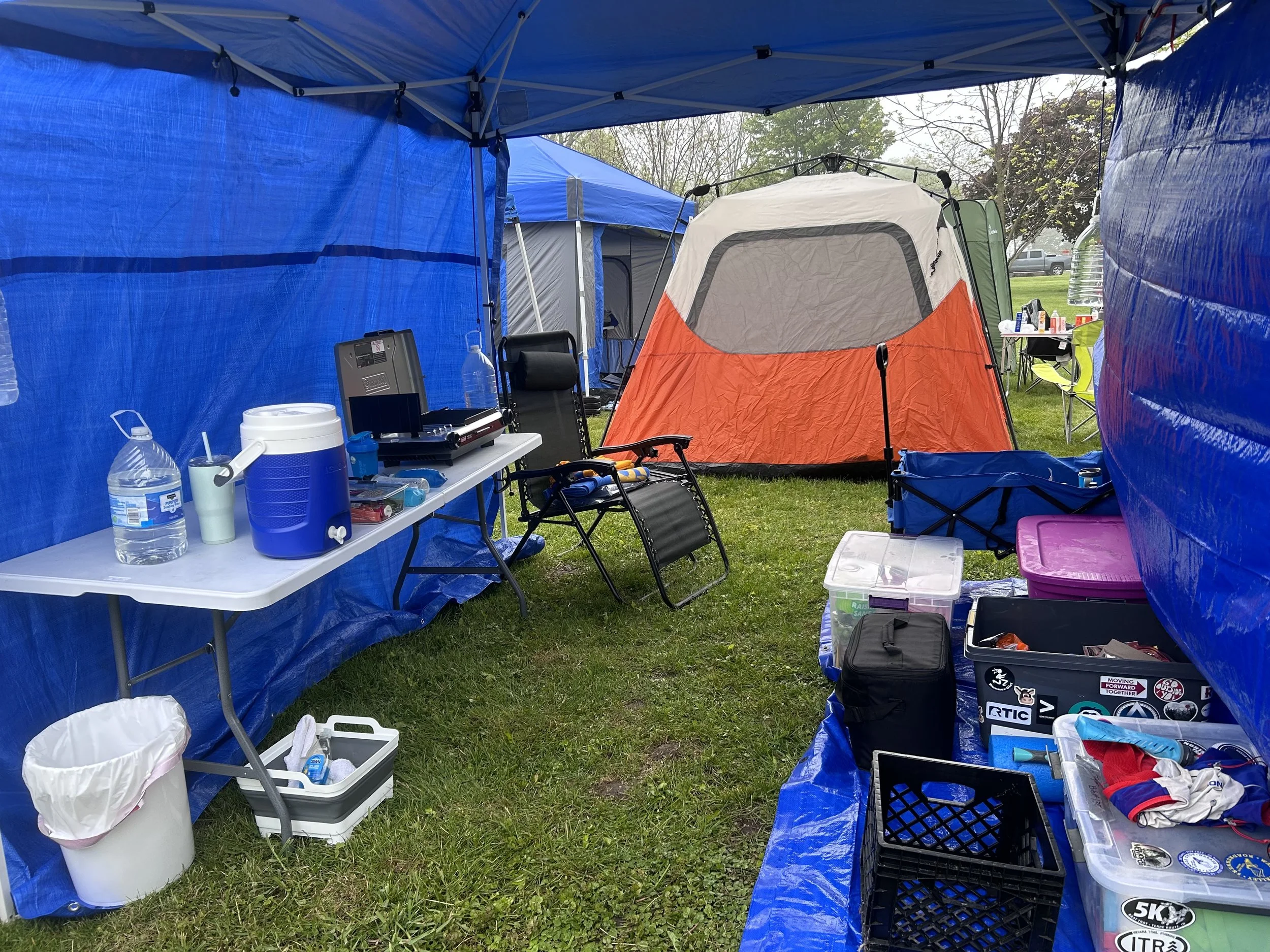
My strategy going into the race was to intentionally use most of each hour instead of banking huge amounts of recovery time early. My friend Hannah came to crew for the weekend, which turned out to be one of the smartest decisions of the race. Earlier in the week we met to plan race strategy, nutrition, pacing, and how we wanted our little headquarters set up.
We decided to target roughly 52 minute loops for the first 12 hours, then allow a little more time overnight as fatigue built. Most loops ended up landing consistently between 50 and 53 minutes, with a few slightly slower overnight loops later in the race. The course itself became much tougher over time than I expected.
It started through a wide grassy field alongside cornfields — or maybe beans this year — with uneven footing almost the entire way. There weren’t many long smooth sections, so you were constantly weaving around ruts and searching for stable ground. That section lasted for over a mile before we popped out onto a gently rolling gravel country road leading to the turnaround.
The turnaround section became one of the most psychologically interesting parts of the course because you could finally see the spread of runners ahead and behind you. Every hour you’d quietly assess who still looked smooth, who was struggling, and who seemed way too comfortable for the mileage everyone was stacking up.
Around mile 2.5, the course shifted onto a paved country road leading back toward camp. Near mile 3.8 we’d pass our tents, where I could always count on seeing Hannah cheering and waiting to check in with what I might be needing next. Then came one final rough section back into the property alongside a cornfield where the tire-rutted path became so uneven it honestly felt easier just to run in the corn itself before returning to the start/finish area.
We set our tents directly near the corral, and I quickly realized how precious those few recovery minutes really were.
Even early in the race, I was using nearly the entire 10-minute recovery window every single loop. Refueling. Changing layers. Discussing strategy with Hannah. Mentally resetting. It felt rushed immediately, which surprised me.
Meanwhile Hannah had our camp running like a military operation.
She brought a camp stove and cooked throughout the entire race. Sausage. Bacon. Potatoes mixed with ground beef. Grilled cheese. Ramen. Every loop I’d come in and food would already be waiting. I didn’t have to think. I just had to eat.
More importantly, she tracked everything.
Every calorie. Every electrolyte. Every serving of Skratch Super High Carb. Every Ketone IQ. She reminded me when I needed more sodium, more fuel, or more fluids, and she kept me accountable to the caffeine and sugar limits we’d discussed before the race.


It’s funny how quickly your brain starts failing in backyard ultras. Even simple decisions suddenly feel overwhelming when the clock is constantly counting down toward another start. Hannah never let the chaos take over. She brought exactly the level of structure and discipline I needed to keep moving efficiently.
Around the 12-hour mark, the race changed.
At first I’d been intentionally holding back to protect my legs. By then, I realized I wasn’t “slowing down strategically” anymore — that had simply become my actual pace.
We dealt with relentless winds throughout the day, with gusts reaching around 24 mph across the exposed farm sections. Fighting those winds hour after hour drained energy faster than I realized. But Hannah kept updating me that conditions were supposed to calm overnight, and for maybe the first time ever in an ultra, I found myself genuinely excited for nighttime to arrive.
She was right.
As darkness settled in, the winds finally died down, and mentally that felt enormous. I no longer had to battle both the course and the weather simultaneously.
Then Mary arrived.
Mary showed up around the 12-hour mark, and I cannot overstate how much of a boost that gave me. We've spent over a decade racing ultras together, and she understands endurance racing and honestly me at a level very few people do.
She took over the overnight crew shift so Hannah could finally rest, and she brought coffee.
At that point, seeing Mary with coffee felt like a religious experience.
Mary immediately stepped into full ultra crew mode. Every loop she made sure I ate, even when I didn’t want to. She helped me swap wet clothes to stay warm, reminded me to use the bathroom while I still had easy access to porta-potties, changed shoes and socks, and continued the fueling structure Hannah and I had established all day.
Then she’d shove me right back into the darkness for another yard.

Our fueling strategy was one of the things I’m proudest of from this race because it stayed surprisingly controlled for such a long effort.
The plan was zero caffeine until nighttime. During the day I focused primarily on protein, electrolytes (LMNT and coconut water), Skratch Super High Carb drink mix, and Ketone IQ for energy without caffeine. I intentionally kept sugar intake fairly low early on.
Overnight I maintained the same structure but replaced some Ketone IQ servings with small amounts of coffee when needed.
Around mile 60 I took my first dose of Tylenol, then one more later around mile 84.
When I crossed the 100-mile mark — which also happened to line up with the start of a new day — I mentally reframed the race. I needed to feel like I was beginning an entirely new event, just with exhausted legs.
To create that reset, I intentionally shifted my fueling briefly toward quicker sugar sources like GU Roctane and cookies before transitioning back into the previous day’s steadier nutrition approach.
Those loops actually felt pretty good, but I could tell things were changing. I needed to walk more strategically to preserve my legs and feet, and that becomes increasingly difficult in backyard ultras because more walking means less recovery time at camp.
My race ended after 26 yards — roughly 108.3 miles.
By then I was dealing with some upper GI inflammation unrelated to the race itself, and the pain reached a point where I wasn’t comfortable continuing through it. I was also simply tired.
Very tired.
At that stage we were down to three runners: myself, Josh, and Abe.
Josh looked strong literally all day long. Since he stayed ahead of me most loops, I’d see him at every turnaround still moving smoothly and confidently. Abe, meanwhile, had locked into this incredibly steady rhythm that looked like he could sustain forever.
I knew if I continued, this race was likely going several more yards.
Part of me desperately wanted to keep fighting. It had become Mother’s Day by the time Sunday morning arrived, and I really wanted to take the win for the women out there cheering. And I wanted the quilt. I wanted to keep proving something.
But I also knew it was time.
After yard 26, I looked at Hannah and said, "I'm not sure what this pain is in my back, but I'm worried about moving forward with it and making it worse. Also, look at those guys. This is going to be a fight that I'm emotionally ready for, but I think this is my sign. I need to check in with this and listen to my body."
Listening to your body sounds simple, but it becomes incredibly hard after you've already spent more than a day pushing through some pretty significant painful moments.
Earlier in the race Hannah had made a sign with a checklist of reminders to keep me moving and keep my head in the right place. One of the most important things written on it was:
"Don't quit in the chair."

And I didn't.
With Hannah by my side, knowing this might be it — but probably hoping I'd change my mind — I stood up and made my way toward the starting corral one last time. I gave one final strong walk toward the line, looked my competitors in the eyes, and headed out with them for a few short strides before wishing them the best and turning back toward camp to take my official exit from the race.
Hannah walked me back toward the tent, and I could feel myself getting close to breaking down. But instead, I realized I was actually pretty happy with what we had done as a team, and that's what I wanted us to remember in the end.
And honestly, one of the strangest and most beautiful parts of backyard ultras is how deeply connected you become to the people you're competing against and with your crew.
There’s a lot of ego in racing. Even the kindest ultrarunners show up with big goals, high expectations, and the same desire to win. We all toe the line believing in what could be possible on a perfect day.
But backyard ultras do something different to people.
When you stand beside the same runners every single hour, sharing the same exhaustion, uncertainty, pain, weather, darkness, and tiny victories for an entire day and night, something shifts. You stop racing against strangers and start surviving alongside them. Everyone out there is fighting some version of themselves.
And the longer the race goes, the more you realize that we all show up on race day with the highest expectations for ourselves, but ultimately leave with what is possible for us that day. At the end of it, I think what most of us really want is to look back knowing we gave ourselves, and the people crewing and supporting us, the best we had to give.

My Girls <3 Mary & Hannah
Somewhere along the way, you start cheering for each other.
That's the part that feels so human.
In the hardest and most painful moments, you desperately want relief from the suffering. But at the exact same time, you also want to keep going because you become invested in watching everyone else's race unfold too. You want to see who figures it out. Who hangs on. Who surprises themselves. Who breaks through something they didn't think they could.
It's the strangest feeling.
You still have to run every mile yourself, but the support, kindness, and shared suffering carry you farther than you thought possible.
I finished the race after 26 yards, covering just over 108 miles, placing third overall and setting the women's course record on the new course configuration.
Somewhere out there over those miles, I was reminded that what I found in ultra running over a decade ago still exists inside me:
The need to find out what is possible.
I think I found something that fits my running style and abilities in a way I did not expect, and I'm pretty excited for the next challenge and to see how far I can go in the backyard ultra format.
What took me so long?
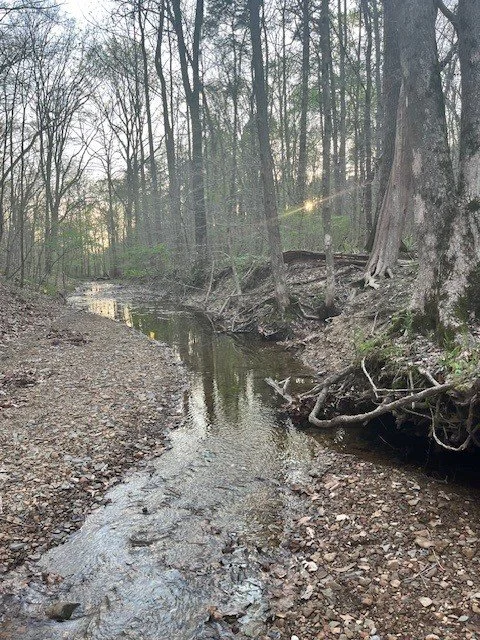
Knobstone 50 is Wild and Beautiful
The Knobstone 50 is Wild and Beautiful
It’s April 13 on a Monday morning and I can’t sleep. My legs still feel like they’re climbing and my mind keeps replaying the terrain like I’m still out there. Knobstone 50 ended Saturday night, but my body hasn’t quite realized that yet.
Racing is literally one of my favorite things to do. Now, while I’m in the middle of it I’ll tell you a different story, but it’s all of it. The long months of training, gear checking, nutrition dialing, searching and studying races, the planning and prep for race day, and the way the air smells when you leave town and begin the road trip to put all that together.
My spring race this year was the Knobstone 50. The course is on the Knobstone Trail in southern Indiana and is known to be a rugged and wild course to traverse, with some serious elevation gain and loss that makes the course a challenge for footing and climbing, and not to be overlooked, the descents.
Last year in 2025 I rolled my ankle around mile 2 to 3 and hiked it in to drop at the 10 mile aid station. On that hike I was amazed by the silent beauty around me. I knew that day was supposed to be a hike and a reflection on the power and amazement of Mother Nature. I knew I needed to slow down and find something. I just wasn’t sure what that was yet. But in that knowing, I knew I’d be back.
I signed up for the 2026 race as soon as it opened, and then I floated back into the business of mom, job, race director, and grad school life while knowing I’d keep the goal alive by keeping my running solid through winter and maintaining a base mileage, which I do anyway just to keep the other stuff in check.
Indiana has some challenging trails. In December 2025 I ran Jackson 100K in southern Indiana, which looking back is the same kind of hard as the Knobstone Trail. I’m going to say these two races are the hardest races I’ve run, and not just in Indiana. They are both relentless with the climbing. Many steep grade loose rock, rooted, and leaf covered trails. Jackson is back to back with some of the steepest long climbs, and it’s a looped course so you get to do the same big climbs over and over and over…
Knobstone has some of the same steep climbs with steps nailed in with rebar on many of them, which can be helpful if the steps are there and random rebar is not sticking out where a step once was. But that’s not it for Knobstone climbs. There are also many shorter steep climbs and long gradual climbs that just keep going.
Both of these courses have long stretches of runnable winding trails that take deep into the woods and right into the middle of nature. You can stretch out and run and breathe in the air that holds all of that nature in it. It feels like coming alive after working really hard to win that breath. Okay, I didn’t know this was turning into a comparison of these two races, but I guess I’ll just go with it.
It’s amazing to feel like you can’t push anymore and then come off a crazy climb and your legs are still ready to run down or across the flats. It’s also amazing that you can keep doing it over and over for 50 plus miles.
Because that’s what Knobstone is. You’re climbing and descending so much that your muscles are a constant reminder of the work it takes to navigate these trail systems. But somehow when the trail opens up and gives you long winding runnable scenic raw nature, you’re able to still get into the rhythm of your run pattern and enjoy it the way a runner enjoys being on a trail.
Connecting and falling into a rhythm with the life going on around you that didn’t ask you to be there, but is letting you become a part of it in the way you know how to be a part of things. Running your natural pace, breathing to the steps, following the trail, and watching the scenes come alive around you in that synchronized experience.
It’s amazing that the millions of forms of life around you work together to create that moment, and today you get to be a part of it for a while. It has been there for many years before you, and it will be there for many years when you’re gone. It’s truly fascinating and I’ve never been able to experience anything like that except through running.
And on this Monday morning I don’t want to go back to the other rituals that make up my life, but I’ll forget that by noon today. I’ll be further removed from that experience and back to the routines that unfold here, away from that air. But what gets to stay is the reminder of what is important.
What is important.
What is not important.
And how I want to show up now.
So yeah, hiking out of Knobstone last year with a swollen ankle and being forced to slow down ended up being part of the plan. It brought me back a year later to experience the trail in motion, but with an added sense to appreciate what’s around me through movement and feeling, not just by looking at it. It’s kind of profound.
Race day.
The night before the race I stayed overnight in the women’s lodge with a couple of others racing the next day. Since Knobstone is a point to point race, this setup is really convenient if you don’t have crew or a pacer and are kind of winging it solo. It’s also a great option if you want to stay after the race, get some sleep, and travel home the next day once you’ve had a chance to rest.
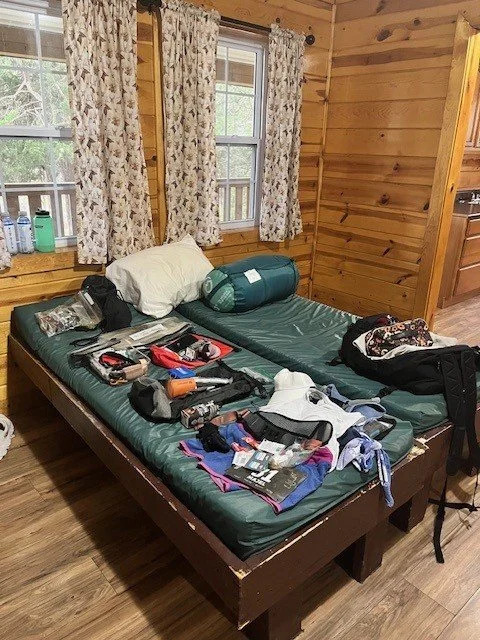
Getting drop bags ready at the lodge on Friday night.
For anyone considering it, the lodge had everything you’d need. There was a stove, refrigerator, coffee maker, a small kitchenette area, and a full bathroom with a large shower, hot water, and AC and heat. It was also just a short walk to catch the bus in the morning.
Because it’s point to point, the bus takes you to the starting line. It’s about a 45 minute drive and they get you there roughly an hour before the race starts, so it’s definitely an early morning.
I slept pretty well in the lodge and got to meet some like minded runners and have some great conversations. The temperatures were a little chilly, so I dropped my bag in the morning so I’d have somewhere to stash my warmer clothes once the race started.
The morning energy was great. Everyone was excited and ready to go. There’s plenty of time between the bus ride and the start to take care of morning routine stuff, talk with other runners, or just take a few quiet minutes alongside the woods before the day begins.
The route takes you away from the park and gives the field enough time to separate into their pace before lining up on the trail in single file. It’s still night at 6 a.m., so we’re all in headlamps, watching our footing and easing into the change in terrain. I was especially on alert so as not to repeat last year’s injury.
I started further toward the back of the pack this year to avoid getting caught up in running too fast so I could lock into navigating the trail footing and focus early on the expectations of the root systems.
Since the race starts in the dark I decided to leave my hiking poles at the first aid station that allowed drop bags, around mile 17. I wanted to move gradually into the day and not have things in my hands to think about for a while, but I knew they’d be nice to have for the climbs and later in the race I’d be glad to have them as an option.
My breathing was off for the first 20 miles. Heart rate wasn’t a problem so I kept going and knew my breathing would sync at some point. I stayed low and slow, letting people pass me and stepping aside when I felt that was needed. I’m really proud of myself for that little victory. Learning to run your own race is something that has taken me many years to appreciate.
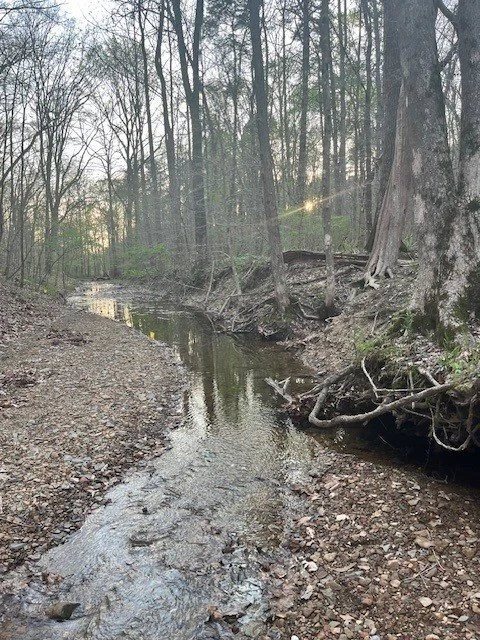
The climbs came fast and the first part of the course had some wicked downhills that were steep and sketchy. In the beginning all of the downed trees were fun to climb over, jump, or crawl under, but I’ll be honest I stopped having fun and started rolling my eyes around mile 20 when I realized I’d be jumping trees all day. There were just as many creek crossings but all were jumpable and my feet stayed fairly dry.
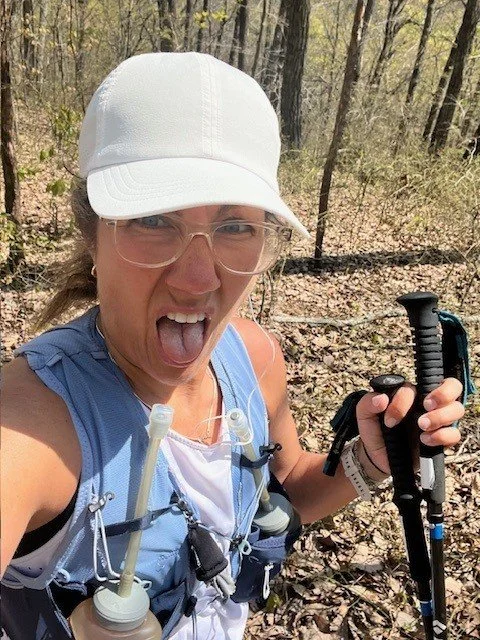
Before another climb, or after jumping another tree… or both!
Gear check.
I wore the Mount to Coast T1s for the whole race and was very happy with that choice for this course. The technical aspect of this trail makes it a good idea to have shoes that let you feel the trail and stay close to it, but these shoes do that while still giving enough support and comfort to go the distance.
If the race had been longer I might have wanted to switch into something more cushioned like Hoka Speedgoats later in the race, but maybe not. I’m still undecided about that.
The shoes were excellent for digging just enough into the trail to manage a good pace, jump onto a tree crossing and balance off it if needed, and they drained quickly when I did get water. The technical downhill sections were great because my toes didn’t jam into the toe box. The lacing system helped with that because I could lock in the midfoot separately.
I didn’t fall, but I stubbed my toe and did one of those falls that never fully happens but you’d probably have been better off just falling. The toe plate saved me a few times on rocks and roots. This shoe is somehow both nimble and comfortable and is very reliable for longer distances.
The weather warmed into the mid 70s and with several creek crossings I wanted to make sure my feet were ready and that I had thought through any places that might chafe. I used Salty Britches on my feet and anywhere I thought problems might start.
I first tried it back in January when I ran a 100 miler in Florida. I had only heard about it the day before that race and used just a little to test it. This time I committed to it.
And it worked. I didn’t get a single blister. Not one. Considering I had only run about fifteen miles in these shoes before race day, I was honestly pretty worried about how my feet would hold up. Salty Britches absolutely came through and it’s now part of my race kit.
The quick lacing system took some getting used to, but when your feet swell the lace chain being adjustable at both ends is a brilliant option. I didn’t need to adjust them during the race, but I’m glad I had time to dial in the fit during training.
Nutrition
Let’s talk nutrition. In recent years I’ve done well racing in a fasted state and relying on stored fat for fuel. Running low carb requires pretty strict attention to that system so you don’t start losing lean muscle mass. Since I’m not very good at maintaining that approach anymore, I had to go back to the drawing board.
Before low carb training I raced for years using a higher carb and protein mix that worked well for me. After digging into the different carb powders and ingredients, I landed on Skratch Labs Super High Carb drink mix. The primary carbohydrate is cluster dextrin, which moves through the stomach a little quicker and helps reduce sloshing or other stomach issues.
In the past I’ve also done well with maltodextrin, which you can actually mix yourself pretty affordably. It’s just not something I’d recommend trying on race day if you haven’t practiced with it.
So the fueling plan for the day ended up being Skratch carb drink, Owyn protein shakes, on course electrolytes which I think were Tailwind, plus some LMNT I brought along. I also used one packet of MT Ops Ignite spaced throughout the day, PB and J sandwiches and peanut butter pretzels at aid stations, and I even attempted a hamburger without the bun (shout out to ITR).
The surprise food of the day was oranges. I’ve never grabbed them at aid stations before, but they absolutely hit.
And in the last eight miles I choked down some Rocktane GU, mostly out of habit because that late race sugar boost usually gives me the push I need to finish strong.
Back on the course.
Trail markings were adequate. The course follows the Knobstone Trail so you mostly just follow the white blaze markings on the trees, but I’d recommend downloading the map which works offline. I needed it a couple times, but I get lost in my own little world and sometimes when I snap back I’m off course. That’s on me.
My struggles came mostly between miles 25 and 35. The stretch from 25 to 32 is a big gap after you’ve already been out there a while. It started getting hot and I ran out of water a couple miles before the aid station.
Luckily I dropped my second bag at mile 32 at Elk Creek and had my carb and protein mix ready to get me back into the game. I took some extra time there to fuel properly and made sure I had plenty of water and electrolytes leaving the station. It took a few miles to recover from that but then I got into a really nice running flow for big sections until the last aid station at mile 44.
There are a few more big climbs near the end that feel pretty hard, but there are also some great running sections that let you get into a good rhythm again.
I noticed that I didn’t feel overwhelmingly ready to be done racing at the end of this race like I have in many others. Thinking back to the 2025 race and hiking out when I didn’t want to leave yet, I think that’s where I was at the end of the 2026 race. Just really glad I was able to make the distance and see the course all the way through.
Just wanting to slow down and find something there and keep the moment as long as I could.
Crossing the finish line felt amazing.
Knobstone 50 is wild and beautiful.
Shout out to my friend Shad, who I’ve raced and traveled with for years. He drove and, even after his race didn’t pan out, stuck around to make sure I didn’t forget half my gear and got back safely to Terre Haute. Adventures are always better when you have someone to laugh with and share the miles, both on the trail and off!
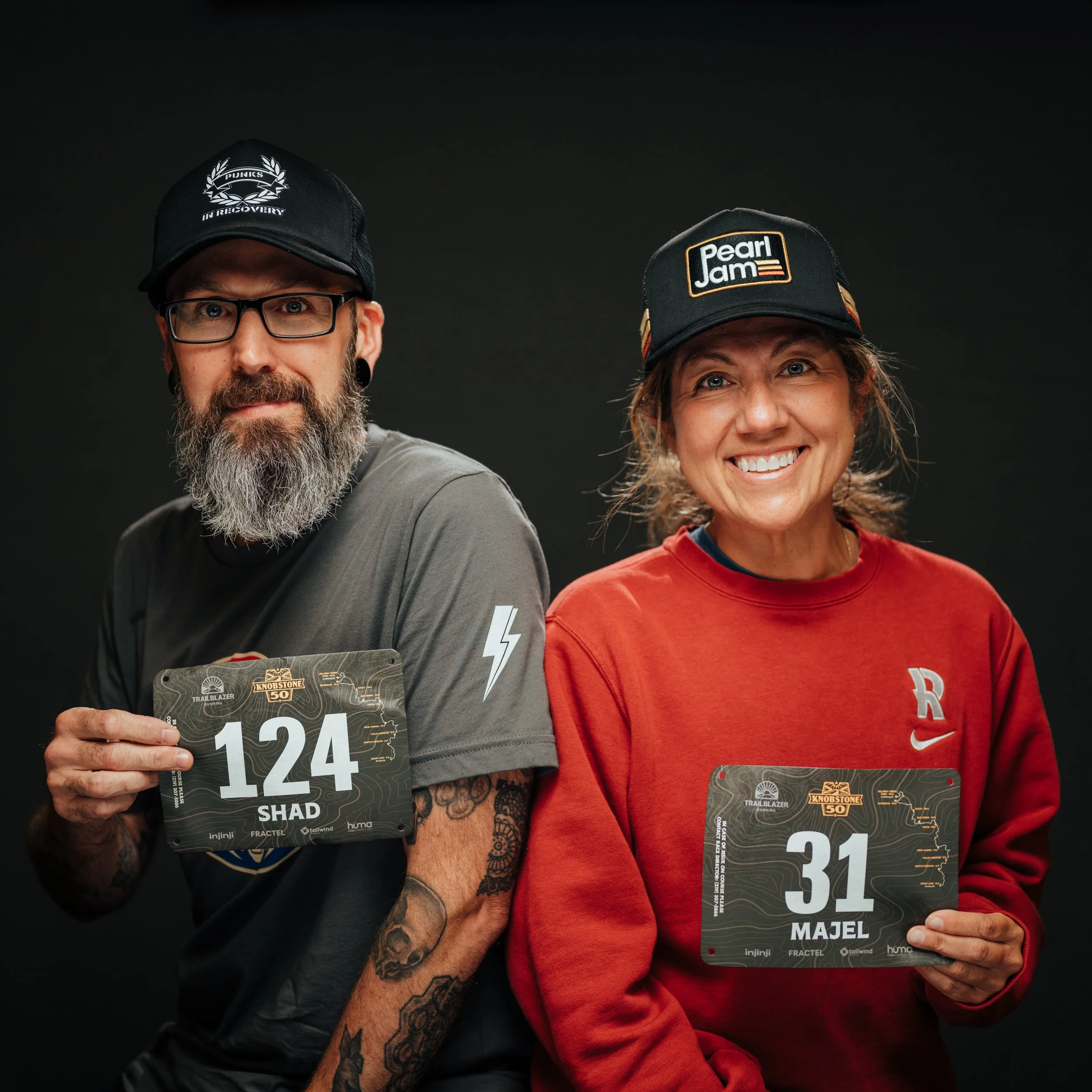
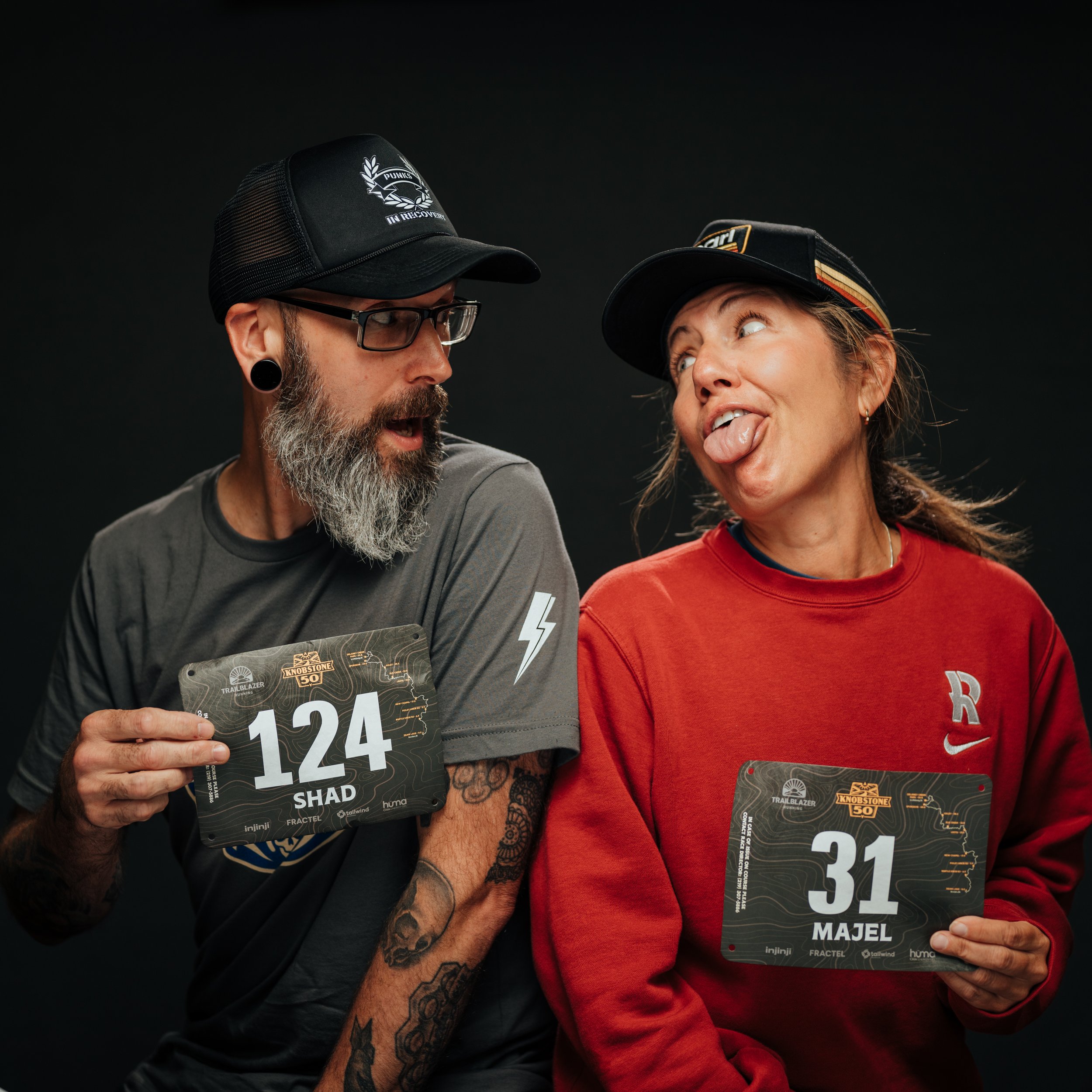
This year, I raced for the joy that running brings to my life. For the moments when it’s hard and I don’t think I can climb another hill, and for the moments when everything falls into rhythm and I feel in sync with the trail and the obstacles in front of me.
I also raced for the times when we don’t finish what we started. When things don’t go the way we planned but we still manage to find the lesson in it. Learning to be okay with what might look like failure at first, and coming through the other side a little better for it. Fighting smarter, leaning in, listening longer, and growing through the process.
My best friend just had another knee surgery and will never know what it feels like to run. I thought about her a lot out there, especially during the hard miles. And when I crossed the finish line and felt that rush of joy, I thought about her again. It’s the same kind of joy I feel in our friendship.
Sometimes the things that reward us the most in life aren’t the easiest to come by. But the hard and the joy often live in the same place.
We can do the things that are hard.
We can do the things that are easy.
They both have their time and place in life and in running.
And without one, do we really have the other?
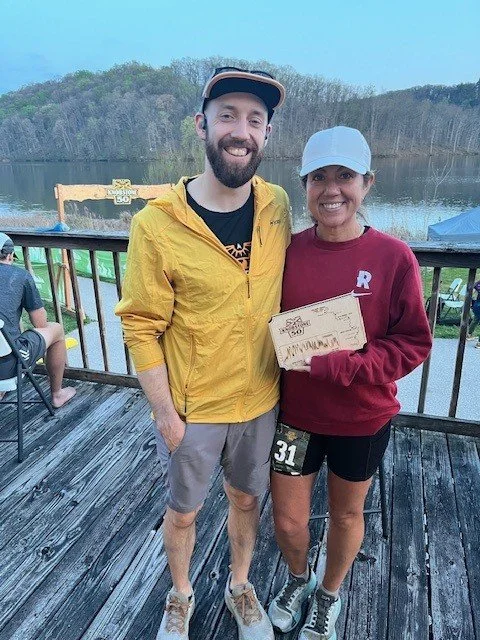
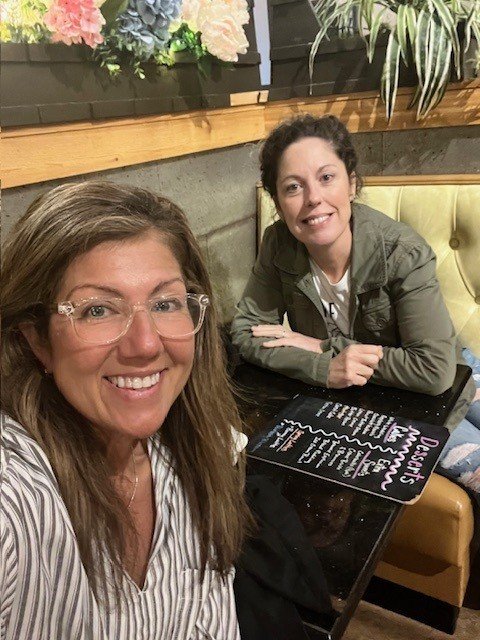
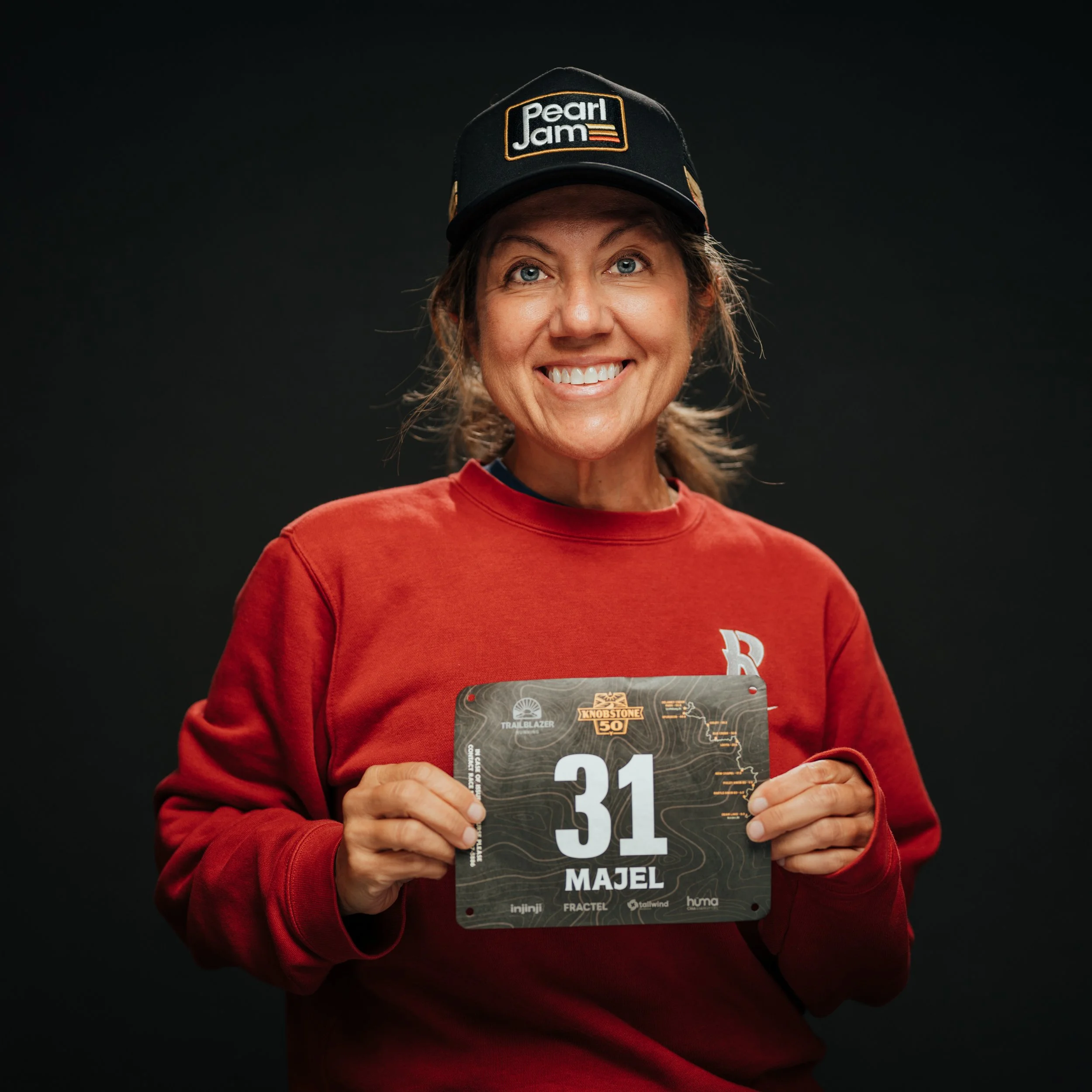
Photos from left to right: pic with RD Kirk and my finisher plaque, lunch date with Jen before her surgery, bib portrait at packet pick-up on Friday.

Run Rabbit Run 100 Mile Race
Run Rabbit Run 100 Mile Race
Run Rabbit Run (RRR) hit my radar in Wyoming 2022 while running Big Horn 100. It was a very odd number of conversations that lead me to register in 2023. Fast forward to February after finding out I (once again) did not get into the Leadville or Western States races via the lotteries my mind quickly shifted to make RRR my A goal race for 2023.
Training
Sooo, I qualified for 2023 Boston and was entered into the May race. My early 2023 training focused on having a good time there, but also continuing to work toward my mountain goals. Hard mix but it was a lot of what I love. I still had my fun easy long runs on the weekend but had to add some speed work in midweek and mix that into a longer distance, lots of mountain leg lifting with the Sally McRae app, and when summer hit, I was trying to strengthen my lungs by hitting the speed in the hottest parts of the day. A couple months before the race I stayed on the trails and worked on fast paced hiking. The treadmill had it’s fair share of 15-25% incline mileage at 5 a.m. on weekdays!
I’m throwing nutrition in here because that goes hand in hand with training. Food is very personal and works much differently for everyone. For me, it’s protein, and lots of it. My primary diet in training is leafy greens, nuts, animal protein, and little to no processed foods (microwave popcorn is a food group). Plant based protein powder for hard training days with beet powder (I also use this for racing). Lots and lots and lots of water!! Half your body weight in oz a day is good math. I’ll add here that I practice intermitted fasting 16/8 with a eating window starting at noon-1 and closing at 7-8 p.m. each day. I’ve never been a breakfast eater and fasting is good for you. It reduces inflammation and naturally allows your body to flush out bad stuff. Google it or ask me for more information. I could write a book!
Why RRR?
As I mentioned before, several folks I met out west when running Big Horn raved about this beautiful course. Leaving that race I couldn’t imagine a more beautiful scene, so I guess I had to go see for myself. Also, when I DNF’d (Did not finish) a few mountain race attempts back to back in 2018/19, I found a coach that helped me fill in the gaps in my flatlander training. And coach Josh talked a lot about RRR and even won it a few times. So, I guess It was meant to be.
Let’s Go!
My daughter Emy had a horrible experience with flying a couple of years ago, so we decided to drive to Colorado. We left TH Tuesday, September 12th for a Thursday arrival in Steamboat Springs. My daughter Katlin (Jewel) flew into Denver from Reno on Wednesday and traveled with us from there. My crew was set – Tim, Emily, and Katlin. We got to work on the drive talking about logistics for when to expect me to come through crew spots, what my needs might be, and just really talking through the course. This would be the highest elevation for me over the course of that many miles. And being from sea level, I wasn’t sure what to expect. So, we had to be ready for the worst.
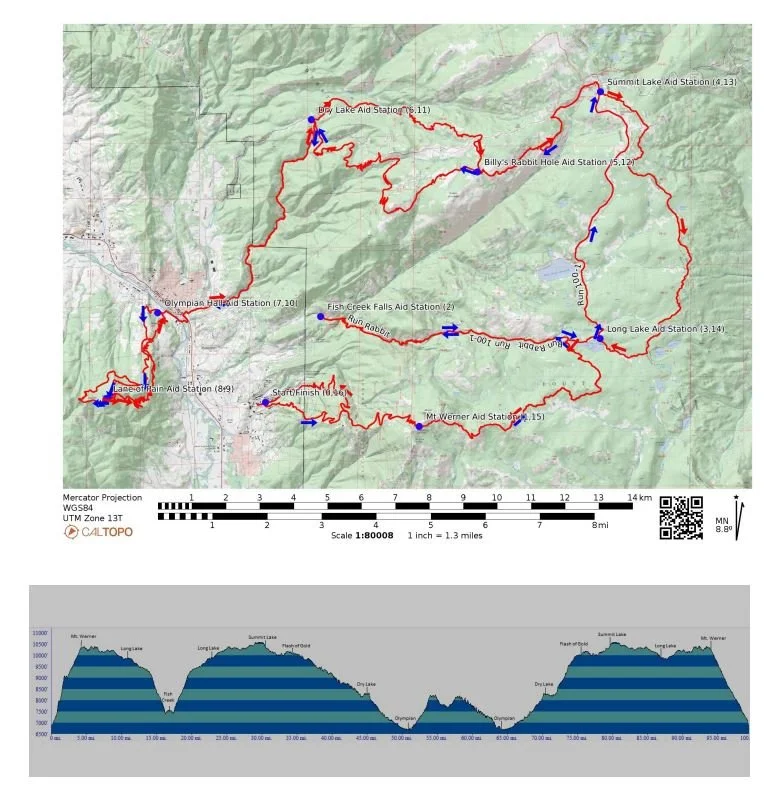
Run Rabbit Run 100-mile map and profile chart.
Packet Pick-Up
We got to Steamboat Springs around 1 p.m. and check in our hotel wasn’t until 4 p.m. so we wandered around the ski town locating the start line and talking to locals. We grabbed lunch at a very local spot Backdoor Grill where we had the best fried pickles ever. Our waiter’s friend had been training for RRR for the past 5 months and he was telling us how hard his training was getting and how he swore he would never train for a 100 again. I let him know that he’d be hooked and this time next week on ultrasignup looking for his next hundo!

Best fried pickles EVER!!
Packet pick-up was at Olympian Hall in Steamboat – drop bag spot/crew spot (51 and 64 miles) – and race debriefing. It was raining off and on, but runners came out for it. After grabbing our race packets and dropping off our drop bags we gathered on the field outside the hall and the RD and his crew came out on the balcony from the second floor to go over all the important details. They also gave away lots of great stuff from the sponsors. This was the first year for the race to be covered live on YouTube, so there were lights and cameras and some interviews with fast people (Hares) going on that made packet pick-up energy on point. I may have had a bit of fan girl going on when I saw Michelle Yates being interviewed. I was also so excited to meet the volunteer coordinator because she has major fun energy, and this is her last year in the position. Well, I didn’t get to meet her at packet pick-up but maybe later?

Hare Interview w/ Michelle Yates
Okay, this is funny (and embarrassing) but I signed up accidentally as a Hare. The race has two categories – Hare and Tortoise. And for this hundo there’s a lot of money for the Hare division to win. But you must be registered as a Hare and fast to win. Tortoises start at 8 a.m. and have 36 hours to finish. Hares start at Noon and have 30 hours to finish. See the difference!? At packet pick-up I was switched to Tortoise thankfully!! But something in me thought…can I finish in 30 hours??

My Hare bib before changing to Tortoise.
Race Day
We stayed at Gravity Haus, which was the race sponsor hotel. The room they gave us was literally next to the side door that opened to the race start. It was unreal!! We exited the room ready to rock and roll at 7:45 a.m. The vibe outside was perfect. It felt very small and personal, yet we were in the middle of a very busy resort town surrounded in a townlike atmosphere of open space restaurants, outdoor activities, specialty boutiques, and a local art festival underway. So much for the crew/pacers/family to do while their runners head straight up the mountain for their adventures. The Gondola near the start line was running for family and friends to ride up and meet runners at the top of the first steep climb.


8 a.m. 355 (tortoise division) runners headed up the ski slope road to ascend to some double track for a tough 4,000 feet to Mount Warner aid station. So right out of the gate we climbed up to over 10,000 feet elevation. This was the first five miles. After clearing that climb, we dipped into a single track, and although still in a tight conga line, I was hanging with others my pace, which felt great. I met Amanda from Golden, CO. This would be her first 100-mile attempt (she finished btw) after pacing her friend at RRR in 2022 for 30 miles. Amanda didn’t know if her runner would make it to her pick-up because she almost dropped. Last year was crappy weather. Amanda found something in her friend that she wanted to experience for herself, so there she was a year later doing the thing. We had a great chat about remote work and the education nonprofit worlds, which we both work in. But she was speedy climbing, so I wished her best and worked through the next few sections very carefully.
It was taking me awhile to get used to running on that type of trail. I kept stubbing my toe and tripping over rocks. I had to get used to my foot placement and it wasn’t coming quickly. I train on dirt trails with a few roots to kick now and then. These trails are littered with all sizes of rocks that I’m just not used to navigating. From Mount Warner (5.4 miles) to Fish Creek Falls (17.7) was descending large boulder rocks. It was mostly hiking for me. It was pretty sketchy, and no way was I going to fall there. I even pulled over to let people pass me so I could take my time. I saw a beautiful waterfall and took that in a sec, but I knew I’d see it again so planned to take more time on the way back. So, yeah - we got to turn around and go up all of that! At Fish Creek Aid I got to see my husband and run a bit with my girls. This aid station was at a park (I think) so there was a nice restroom to break and sit for a minute. Here I noticed I was falling behind on my hydration, so I used my first Mountain Opps hydrate pack – just downed the powder. My husband and kids were appalled (haha!). But I needed it to work quickly!


Back out for more boulder climbing! I had to be even more careful going back because I was now passing alongside everyone behind me on their way out. Which was kind of nice cause runners always say “good job” and “looking good” and someone even said “you’re killing it” which for me is a boost. This would be about a 7-mile section heading to Long Lake. Apparently, the infamous Karl Meltzer is at this station, but I didn’t see him, but I kind of forgot to look. Why? Well, this is the point of the race I started to get very very sleepy. No kidding, mile 24 and I’m contemplating a trail nap. The hard climbing at altitude and being behind on my hydration was starting to kick my ass. At one point I pulled over on the trail and sat on a rock with my head between my legs. A girl passes by and stops to check on me, but I barely had the energy to thank her. Just leave me here to die!!
Somehow, I struggled and made it from Long Lake (rolling dirt roads with more up than down) to Summit aid station where thankfully I had my first drop bag. Folks were sprawled out everywhere fixing feet, adding layers and light for the overnight coming, and fueling up. I totally forgot that my bib number didn’t match my drop bags since I initially had a Hare number. One of the volunteers was trying to help me, but tortoise bag #893 didn’t exist because it was actually Hare bag #124. In my daze I was able to explain this, and we found my bag. I’m sure by the looks of me he was thinking changing from Hare to Tortoise was the best idea I’d ever had!! I really took my time at Summit. We were around 30 miles into the race and already climbed almost 8,000 feet out of the 23,000-race total and a lot of these miles were at over 10,000 feet of elevation. My IT band was starting to feel all of that!
I have this fuel mix that’s my go-to for racing. A combination of plant protein, muscle recovery powder, and beet powder that I take at each drop bag. So I mixed that up, grabbed my IT band brace (more on this later) a jacket, and waist lamp for the overnight and sat for a bit while I let the shake and some aid station food digest. My friend Shad gave me some hydrate and ignite from MTN Ops to try a few weeks before my race. I didn’t have much experience with using Ignite for running, but I used it to replace caffeine a couple of weeks out (so I’m more sensitive to caffeine to use as a tool for racing) from the race and it worked very well for that. I’m a label reader because I stay away from sugar when training and racing. This stuff is loaded with vitamins, amino acids, nootropics, light on the caffeine, and no sugar. I had one in each drop bag (two drop bags that I would pass twice) and was planning to use one at the halfway point around mile 50 and the other when I passed this drop bag again on the way back around mile 80. But this kind of racing is all about trouble shooting and I needed it now! So I added a packet of Ignite to one of my water bottles and set out for Billy’s Rabbit Hole.
We were still hovering around 10,000 feet elevation and the Ignite started working immediately! I couldn’t believe how quickly I turned around and started feeling amazing. I was really worried that I was in over my head with this race when I was already that tired. It was exactly what I needed and all I remember from 30-50 was feeling great and running a lot! I typically have issues with my IT band in mountain races and somewhere in this 20 miles ended up putting the strap around my knee to try waning off the inevitable pain to come.
I made it to Olympian Hall (mile 50 ish) where my crew was ready to assist. This is also a drop bag location for miles 50 and 64. This is also where Tortoises can pick up a pacer. No pacer for me! I’ll be running this whole race solo. From Olympian you go out through “Lane of Pain” and back so you hit this drop bag twice. My husband reported that I picked up some time and was looking closer to a 32 hour finish at this point. My crew got me a new battery for my waist lamp and here I took my first dose of Tylenol. They also had some cheeseburgers, but another thing I was experiencing at this race was stomach issues. I’ve never had issues eating or keeping food down before at a race. I think the altitude was making me sick because I was also nauseous, but at least I had my energy back. And for the next 20 ish miles I’d be between 6,500-8,000 feet and hopefully that would help. I could really tell with my breathing and nauseous when I was above 10,000 feet. Crew was not allowed in the aid station so runners had enough room to get to their drop bags and recover. I was quick at this stop. Grabbed my bag (I remembered my number!), mixed up my shake and drank that hoping it would stay down. It was around 8 p.m. so it was just starting to get dark out. I left my phone with my crew to charge so I’d have it the rest of the race and for music later on. I knew the next section would be rough, so I grabbed some energy chews from the aid station. They were honey stinger brand and I’d never tried them before. They work!
Headed back out, my crew told me they would see me in about 5 miles on my way back. That didn’t seem right to me, but at this point I wasn’t even looking at my pace or elevation chart anymore and runners math is no good. My husband told me to try pairing up with someone on this route, which is known for bears and mountain lions. There was just a ton of climbing and for what ended up being a 13 miles section. Lane of pain kicks off with a long steep climb where I lost sight of anyone in front or behind me. I climbed for so long alone that I started to think I was off course. I decided to trust myself and continued. Finally, I saw headlamps and then an aid station. I found out that I would pass through that aid station again before going back to Olympian and on my second time I’d get a card to return to Olympian. That was their way of making sure runners passed through twice. So, the section was actually a 4 mile out to an aid station, a 5-mile loop around and back to it, and 4 miles back to Olympian. It was getting chilly and that loop section seemed to take forever. Mental note to grab hand warmers when I was back at my drop bag.
I arrived back to Olympian around 1 a.m. meaning that 13 miles took me around 5 hours to complete. Lane of Pain lives up to its name! I’m really beat up at this point. Back with my crew I changed my headlamp battery, grabbed my charged phone and portable charger, hugs, kisses. I told them to go to bed and I’d see them at the finish line. Back inside the aid station I found my bag and spent some time really thinking about my next steps. When you don’t have a pacer and your crew isn’t standing next to you to help you think, you can forget some crucial steps. I kind of just did a check list in my head of anything and everything I’ve ever needed at a race like this. Got my shake ready, ate some ramen, bacon, and cheese quesadilla from the aid station, drank some coffee, grabbed my last ignite, and headphones for the overnight. There was a legit restroom, so I took some time to clean up and splash some water on my face. Tried not to look in the mirror too much so I wouldn’t start feeling sorry for myself.
On my way out I saw several runners down. A few tucked away along the wall curled up in a ball sleeping. Some sitting hunched over with the death stare. Pacers gearing up to start or continue with their runners. Looking around I noticed folks in longer layers and wondered if I should switch from shorts to long pants. I decided an extra layer on top would be enough, and I remembered to grab my hand warmers. I headed outside and quickly turned back around and decided I needed long pants. This is fun because after 64 miles I got to take my shoes off and dress myself standing on one leg. I threw the pants on over my shorts and while I was at it I went ahead and changed my socks. This decision ended up being a very good one! Heading out of Olympian yet again, I had to go back because I forgot my poles! This ended up being about a half an hour stop.
At the pre race meeting the RD says to really consider if you want to continue from here. And it is where several dropped out of the race (DNF). There is no crew or pacer access after the next aid station and if you do drop you will be waiting hours to get a ride back. Onward. What I recall from here is limited in the overnight. The ignite and coffee woke me up a bit and I started feeling recovered from the Lane of Pain and ready for what was next. I left Olympian and navigated through town where I can’t say enough about how well it was marked and how helpful the volunteers were in the middle of the night. They got us safely across Steamboats main street and heading back toward Dry Lake and Billy’s Rabbit Hole to Summit. We were climbing back over steep boulder sections in the night and it became cold and windy summiting the mountains. We were back over 10,000 feet elevation quickly and I started having breathing problems. The cold air and lack of oxygen was making me short of breath and my lungs started to feel sore. I was coughing up chunky mucus. Remembering my friend Mary having similar issues while racing, I took one of my hand warmers and slipped it in my sports bra to warm my chest. That seemed to help. Trying to navigate over these steep sections at night was interesting. Luckily I was with a group and we helped each other find trail markings which were reflective by way of your headlamp and sometimes way above your head in a shrub on top of the next boulder. There were also cairns and dash marks to mark this section of trail that crossed over large sections of granite. My body felt strong which made it more frustrating that my lungs felt weak. I took several breaks to let my breathing catch up when I needed it and just kept telling myself to make it to daylight where it would warm up and my lungs would feel better. This is also the section my watch died, but I had my portable charger and cord with me so it charged in my vest for a couple of miles. Also, I fell hard in this section. I remember laying there on my back thinking I could just stay there until morning. A fellow runner grabbed me up and the damage seemed minimal.
I made it to Summit Lake around 8 a.m. and at 10,300 feet it was a beautiful sunrise at the top of the mountain. My hands were too numb to bother with my camera so I paused and took in the sweet reward. Mile 80 and back to my drop bag. This would be my last chance to ditch layers so I changed out of my tights and into a fresh pair of socks. I had a change of shoes here, but my Hoka Speedgoats were working great, so I stayed in them. I was really shaky and tired so I sat down with all my stuff and took some time cleaning my feet and changing. I can’t remember what I ate, but I dumped my shake all over a table I was propped against. The aid station took care of my mess and helped me place my drop bag in the “going back home” pile. It was still pretty chilly so I layered my jacket (Patagonia find on Poshmark) over my hydration vest and added two new handwarmers to the mix. At one point in the night I swore I my fingers were frost bitten and with one warmer on my chest I used the other one back and forth between each hand, which was tricky while holding poles.
From Summit to Long Lake it warmed up thankfully. This section hits the highest point on the course at 10,557 feet and the course continues to go up and down at averaging around 10,000 feet until almost the end of the race. There were times in this last 15 miles that I felt I was moving so slow that I’d miss the cut off. My IT band was really hurting on the downs and the course was constant climb and descend here. My mind was starting to go dark and I was thinking of the worst things. My headphones had died and all I had was my self talk. My coughing continued but my lungs didn’t hurt anymore so I took that as a win. I was alone for a lot of these last miles. I used the time to work through the climbs as quickly as I could. All I could do was hike. From Long Lake (89 miles) back to Mount Werner (95.8) felt like dayyys!! All I could do was laugh each time I thought the aid station was around the corner and it ended up being another steep climb and descend. It was starting to warm up and a lot of the last sections of the mountain were exposed. I finally reached Mount Werner (last aid station) around Noon. The next and last section would be a six mile descend off the mountain back to Steamboat Springs. My IT band said oh hell no! I rewarded myself with oreo cookies, coffee, and pickles and headed out.
Oh the pain!! I started off hiking down but figured out a way to trot (not run) with a bit of side leaning to take the pressure off my It band. That worked and settled in using my poles for balance. I ended up chatting with a few runners and it helped take my mind off the pain. One of the gals I’d passed several miles back came flying down the mountain with her pacer. I was so jealous!! Running down is my favorite. We passed a ski lodge and entered a single track for the last mile. That was a little less painful and a little flatter, so I picked up my poles and ran a bit. Finally exiting onto the dirt road, the town got closer and all of a sudden I saw my daughters running toward me. I grabbed Emilys hand and Katlin was filming on her phone, which is a great memory to look back on my side leaning hustle!! We turned into the chute after a dip across a small stream and ran it in together. My designated hugger was the volunteer coordinator! So I did get to meet her. My finish time was 30 hours and 52 minutes. Not a Hare finish, but not far from the Hare cut off. Placed Fourteenth female and Fourth in my AG. I’m really proud of this one, and I’m grateful for a few things especially: My crew, My IT band brace, My hand warmers, My decision to switch to long pants overnight, My new favorite race fuel – Mtn Ops Ignite (and my friend who gifted it to me.), and the ability to explore the world in this way.
Next up, Tunnel Hill (which I said I would never run because it’s really flat and a lot of out and backs and that seems really mind numbing to me, but I want to race one more time with all of the training I put in for RRR) in Viena, IL November 11th.
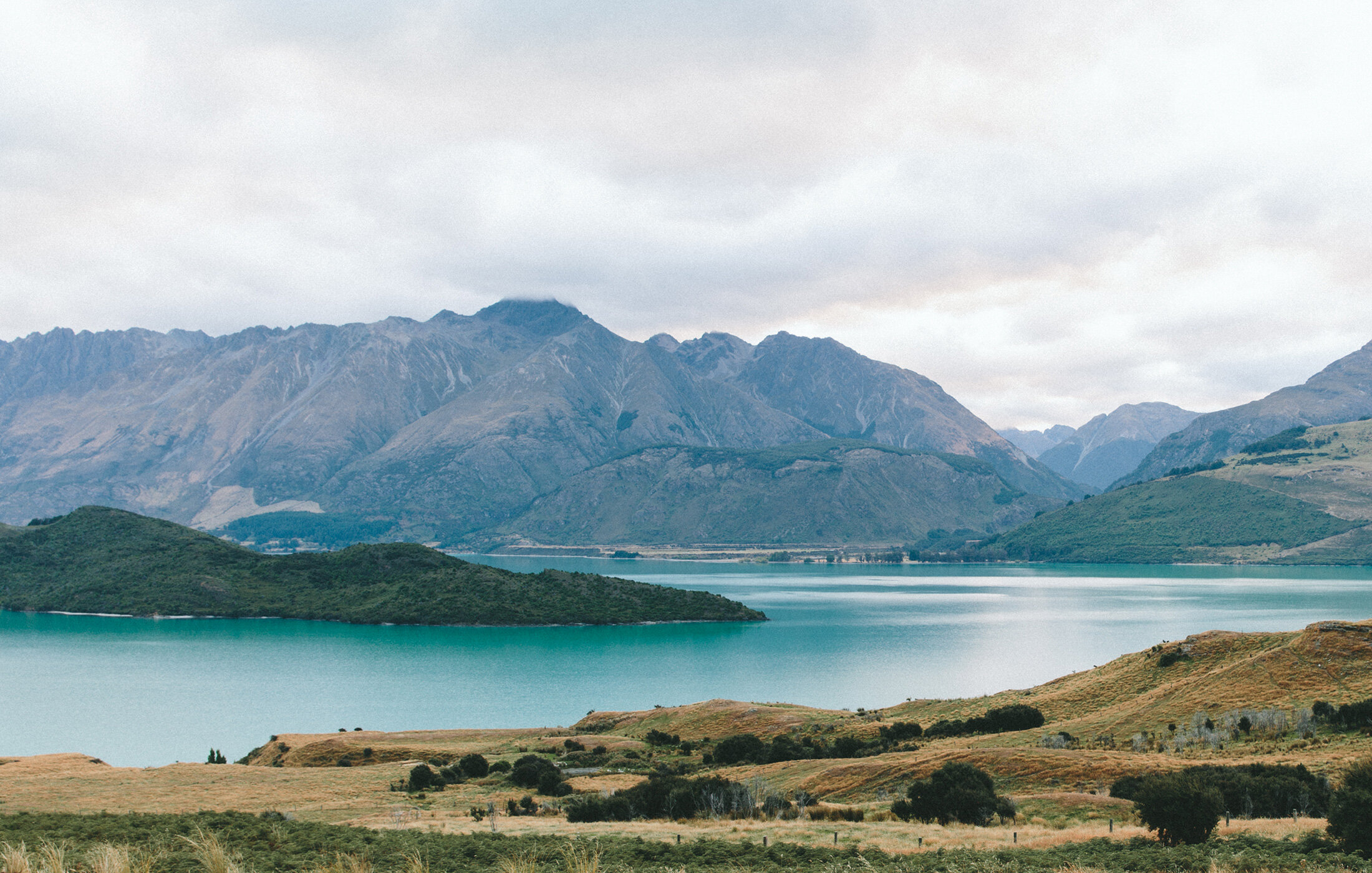
Kettle Moraine 100
It all begins with an idea.
Kettle Moraine 100 is known for selling out fast. I knew this spring would be a heavy lift—starting grad school and adjusting to it with all of my other life roles. But training has to be part of life, and I’m at my best when I have a goal ahead of me. I wanted something tough near the end of spring, but flexible enough that I could ease up on training if needed. This Wisconsin race was the last of the Midwest Slam events I hadn’t run, so I decided it would be my A race—if I could get in.
Registration opened on January 1 at 11 a.m. Central Time. We were driving home from a family trip to Ohio, so I set up registration in the car, ready to hit submit right at 11. I got a message saying I was on the waitlist. The race sold out in less than five minutes. But about 30 minutes later, I got an email from the race director: I was in.
I pulled out my old training plan from Burning River back in 2020 (same distance, similar terrain and time of year) and adapted it to fit my new life schedule. Even though I only took one class, it felt like a full-time job some weeks. I wanted to make sure my family and work didn’t suffer because of this goal. But the class mattered, too. Finding balance was a real challenge. I learned quickly how set in my ways I am. I had to replace my afternoon lounge time with study sessions that often stretched to midnight or later. Weekends became all about what was due Sunday—and many runs had to fit around those deadlines.
Long runs got shorter, but I found creative ways to stay active. Jump squats in the bathroom at work 3-4 times a day. Standing at my desk as long I could while working. Anything to offset missed miles.
I put a 50-mile race on the calendar as a training run for Kettle. It was in southern Indiana, close to home, with about 10,000 feet of climbing—a true test. April 19 was literally the only weekend I had without something due, so we headed to the KT in Borden. Well…I went out too fast, and I think I was doing statistics in my head when I twisted my right ankle. I’d heard people say they’d heard their ankle pop when they twist it for real and this time, I did too. I’ve twisted ankles plenty of times in training and racing and usually bounce back after some walking. Not this time.
I hobbled a few miles and dropped at the 10-mile mark. The next three weeks, my ankle was swollen, bruised, and sore. I could bear weight and flex it, which was painful, but manageable. That gave me hope: maybe I could heal in time to run 100 miles in early June. The KT course looked perfect for a serious training cycle, and I really wish I could’ve finished it. That race is going back on my calendar for 2026. If you’re reading this and want interested in Knobstone 50 hit me up and lets make travel plans for 2026!
I didn’t run for six weeks after that April race. During that time, I was also finishing up race director planning for Hawthorn Half Day (HHD) on May 24 and a hard research project for my grad class. I had plenty on my plate, so I just went with the flow and tried to stay focused on what was in front of me. Having a race to plan ended up being just what my soul needed and I decided to keep Kettle Morraine on my radar.
For two weeks before the hundo, I eased back into running. I stayed on flat ground and built from 3 to 8 miles over four runs, taking rest days in between. I kept up flexibility and strength work, and it seemed to help. But breathing was a different story. After six weeks off, running felt like starting over. Each effort felt like I was breathing through a straw. Even the mental boost from a run was missing. But the energy from HHD kept me going.
We had a family trip to Florida planned the week before the race, and it turned out to be just what I needed. It was hot and humid, and my ankle felt better than ever. I pushed my pace to help regain breathing efficiency and got in a few strong runs. After we returned, I did a 14-mile run. Then it was race week. I did a few 5-milers, still on flat surfaces. I wasn’t sure how my body would respond on trail, but I was ready to try.
Friday around noon, I drove to Wisconsin solo—no pacer, no crew. Just my “Majel’s Mojo” playlist, an obligatory gallon jug of water to consume, and miles between myself and anything pulling at me. As I got closer, the countryside opened up. I could tell this would be a rugged race, as it's on the Ice Age Trail. I had something in me for this race that I hadn’t felt for awhile.
I arrived at packet pickup around 6 and set up my drop bags: one at Hwy 12 (miles 77 & 86), one at McMillers (mile 44), and one at Nordic (start/100K/finish). I skipped Hwy 67 (miles 27 & 36), thinking I wouldn’t need anything before mile 44. More on that later. Hint hint: I was wrong.
It didn’t rain like the forecast called, but it got hot. A tricky breeze made it feel cooler than it was, so I underestimated my electrolyte needs. I didn’t get real fuel until mile 44. The aid stations were well-stocked, but it wasn’t enough. I needed more than I could take in at the stations. I could’ve carried some, but I have a weird thing about putting electrolyte fluid in my bottles. I dry scoop the powder (don’t try this for the first time during a race!) and chase it with water. Same for instant coffee grounds. IYKYK. I wish I’d dropped fuel at Hwy 67. That cost me some suffering with low energy. Especially since my lungs were working harder than normal undertrained.
The first 20 miles were fun. I was conservative and used it to test my body. I ran slower than my usual easy pace. The group energy was exciting. Early spring and summer races always feel electric—it’s usually someone’s first race after a long winter, and the stoke is high.
I met runners from Canada to California and closer to home. One guy said he’d gone to a computer science camp at Rose-Hulman in 1976. Every race, I seem to meet someone connected to Rose.
The 20-40 mile stretch heated up. The meadow sections were long, exposed, and narrow with thin, uneven paths that required total focus. I usually pushed through those sections to get out of the sun, but had to be super careful with my footing. My ankle was not at 100% and TBH I never saw a doctor to know how bad it was when I sprained it. The aid stations on the front and end of the meadow had ice cold buckets of water for head dipping. More than the best feeling ever!!
The 40-60 mile stretch brought evening. The temps dropped as we looped back toward the start. The terrain was hilly with loose dirt, rock, and sand. By mile 64, I was wrecked. The climbing taxed my quads and spiked my heart rate to levels I’m not used to working through. I rarely watch my heart rate since I know my body pretty well in that regard. But I was easily pushing 160 bpm. Rolling into the start/finish (mile 64ish) is a point where you can drop to the 100K, get a hot meal, sleep in your car, and still earn a buckle. It’s not a choice I wanted to have.
I told myself to drop. I was lucky to make it that far with my ankle. A full day of labored breathing had worn me down. My fitness wasn’t there. That might sound irresponsible, but I’ve been racing for 25 years and running ultras for 12. I had a solid base. I grabbed my drop bag and changed into dry clothes because the Wisconsin night was cooling off, and I was soaked. My feet hurt. I sat in the bed of my car way too long thinking about what I would need to do to finish. The longer I sat in the car, the harder it became to get back out. This would have been a good point in time to have crew.
I called Tim. He told me to try a little more if I could, and reminded me I’d be mad at myself if I didn’t. Of course I knew that, but hearing it out loud helped. That inner voice pushing me to quit was really loud.
He was right. I squeezed my swollen feet back into my dirt-caked Hokas, grabbed my hiking poles, and headed back to the start/finish. I checked out the 100K buckle for inspiration. Almost sold. But then I chatted with the RD, who said I should at least hike out to the Bluff aid station, "it’s fun, great food." I know I was tired, but it made sense to me. So off I went.
Once I hit the trail again, it felt good. Peaceful (except for the bullfrogs), moonlit, and calm. I almost cried. Maybe I was just really, really tired. But this—the quiet nighttime section—is my favorite part of racing and I almost missed it.
The next 15 miles were different from the earlier out-and-back. We repeated the first 5 miles, then turned for a new 15-mile stretch: lots of climbing out, lots of rocky descents coming back. Normally, singletrack in the woods is my favorite part. This time, it felt like a game of "did I do enough ankle mobility not to snap something." I was glad I grabbed my poles for the night section. They saved me more than once!
That section took all night. Since it was an out-and-back, I kept moving aside for passing runners. Same in the earlier miles. And with other race distances on the course, fresh runners were flying by when I was already 70 plus miles in. I couldn’t decide if it was more humbling, demoralizing, or entertaining to be passed so much!
Popping out of the single track briefly we hit the amazing Hwy 12 aid station. The volunteers—especially the women there—took care of me and told me beautiful lies: "You look great. You’re so strong." And sometimes in life, you just have to believe the lie.
Eventually, we left the woods and entered the hills for the final 8 miles. The last 5 felt eternal. (I know I say that about every section.) The climbs were brutal. I could still run in patches, so I kept reminding myself: run now, finish sooner.
The final 3 miles were exposed meadows with rolling hills. I saw a woman who ran Hawthorn Half Day. She remembered me and said they’d been cheering for me. It felt so nice at the end of 100 miles to feel community. Her husband, Terrence, also an HHD runner, was waiting at the finish. That gave me a huge boost to push. My final mile might’ve been my fastest of the entire second half.
I crossed the finish line in 26:26:54.
To finish after an ankle injury, six weeks off, and just two weeks of easy running? Wild. Our bodies are amazing. And the mind is even more so. I ran the whole race without headphones or electronic distractions (aside from a couple wake-me-up texts). I wanted to be fully focused. And I was.
The same group of volunteers that pushed me back out at the 100k mark, including the RD, was still at the finish line when I crossed over. When the RD saw me, we both pointed at each other and said, "You/I did it!" We both knew I wasn’t going to drop at the Bluff aid station. We both knew once I pushed out into the darkness that the race would become what I came for.
Sometimes the hardest part is trusting ourselves. We’re surrounded by noise every day, but deep down, we already hold the answers we’re looking for. That’s what this race reminded me - to trust the path I’ve been given. Maybe the real question, whether in racing or in life, is not “should I try” but “what will I miss if I do not”?
Get this race on your calendar—if you can get in. Registration opens Jan. 1, 2026.
Kettle Moraine 100
26:26:54, LaGrange, Wisconsin
100-Mile Buckle #12
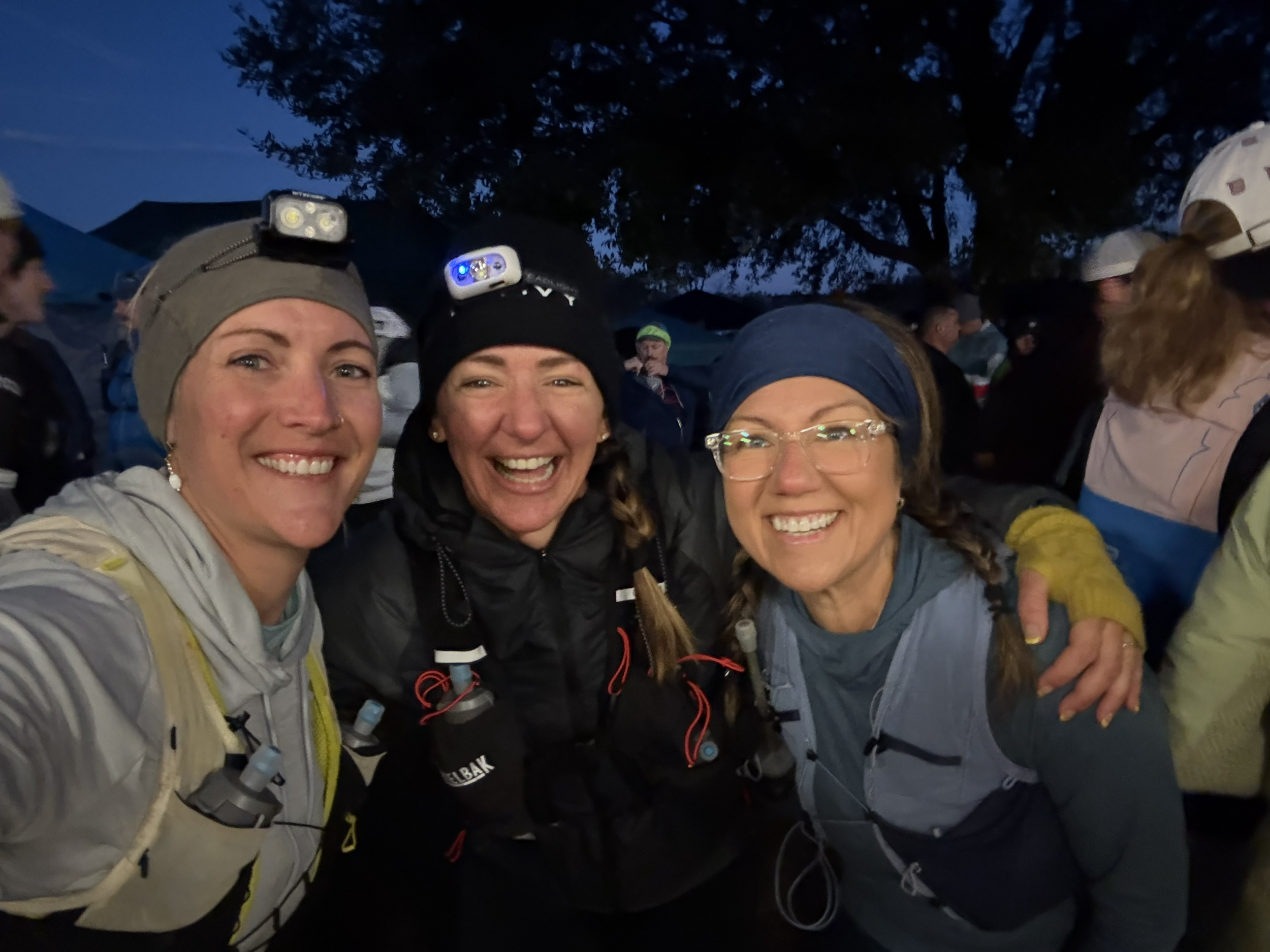
The Hundred Is a Truth Teller (Long Haul 100)
Race recap from Long Haul 100 in Florida: 71 miles, lessons learned, humility, and why the 100-mile distance is a truth teller.
The 100-mile distance demands discipline, both in training and in life.
When you show up steady in those areas, you can have a great race.
But nothing is promised.
Over 100 miles, anything can happen. That uncertainty is part of what keeps pulling me back. It keeps me humble too, because I carry this quiet, personal knowledge of what failure feels like. Not in a dramatic way. Just as a reminder that no amount of planning or effort can fully control the outcome of anything in life.
Some things are earned.
Some things unfold the way they are going to unfold.
The hundred is a truth teller in a world where stretching it is the norm, time is its thief, and the gap between the start and finish line exposes whether you really meant the goal.
The training cannot be duplicated or cheated. There is only one way to prepare: do the work. Physically. Mentally.
Did you prepare for this race?
The drop bag will either have the headlamp in it or not.
Did you plan for this race?
When you settle into the mileage, your physical capability will eventually wear off. You are left with whatever you can tell yourself to stay in it.
Did you need something from this race today?
January 17
On January 17, I toed the line for a race I was not truly trained for.
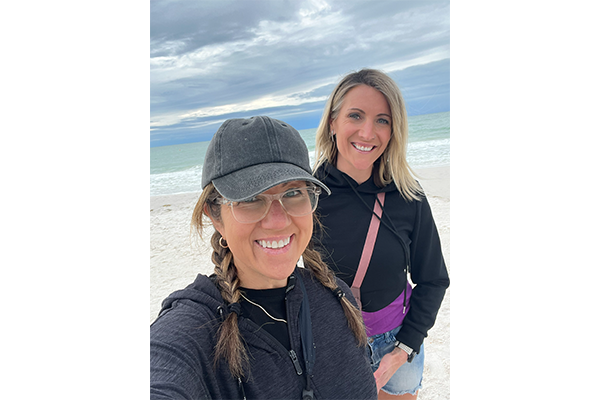
I signed up partly as a way to turn it into a girls trip with my best friend — an escape from the cold Indiana winter, a little beach time, a change of scenery. That part sounded light and easy.
But that is not how you build toward a hundred.
Somewhere in the beginning, the focus shifted. It was not anchored the way it usually is when I commit to this distance. The race became part getaway, part adventure, part “I can probably get through this.”
Maybe my training suffered because of that initial mindset. When your reason is diluted at the start, the work can quietly dilute with it. The focus becomes softer. Less intentional.
The hundred notices that.
An Unexpected Gift
A few weeks before the race, something exciting happened. Sally McRae announced she would be racing the Long Haul 100.
She has been my favorite female elite ultrarunner for over a decade. I have followed her journey, watched her grit, her commitment, her fire. The idea that I would be lining up at the same start line felt surreal.
It is a small race. Intimate. The kind I seek out intentionally. I was honestly shocked she would choose it. But she had just come off surgery and needed to finish a hundred in time to be considered for Badwater 135, and Long Haul fit into her schedule.
We got lucky.
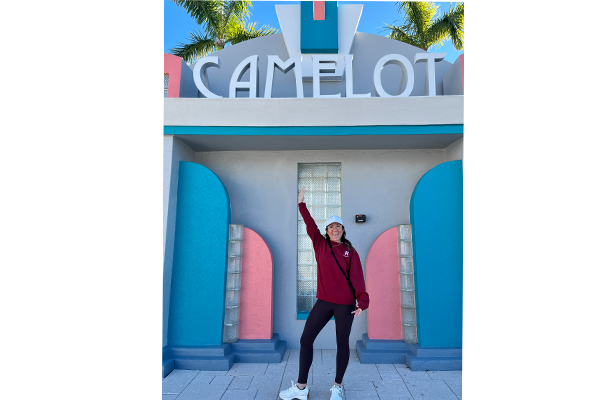
Before the race, we were able to snag a quick photo with her and meet her briefly. It was simple and kind and grounding in a way I did not expect.
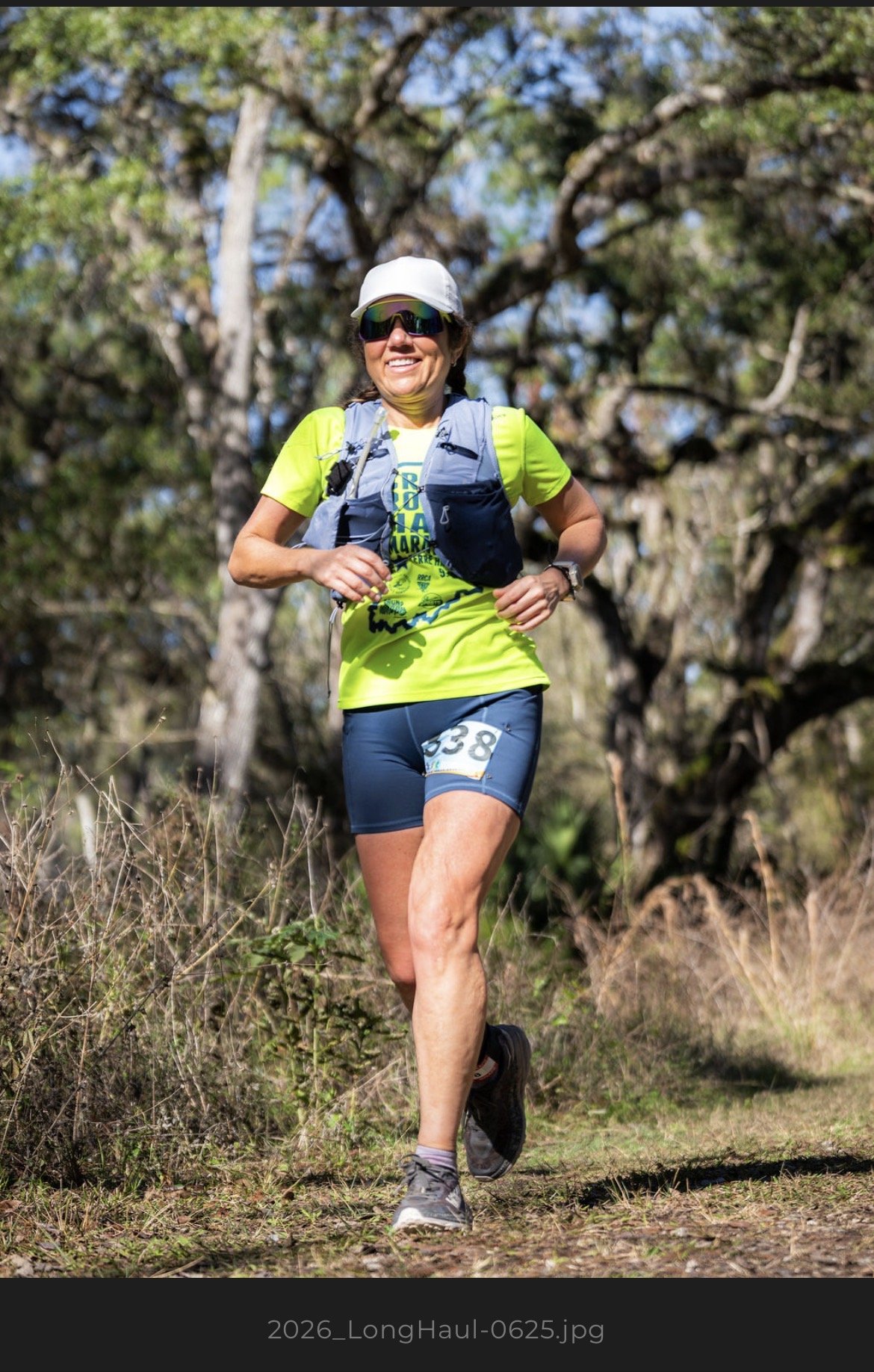
The course had long out-and-back sections during the daylight hours. Because it was small, it felt personal. As we crossed paths several times, I was graced with her bright light — that unmistakable energy she carries. Each pass felt special. Encouraging. Electric in a quiet way.
I even crossed paths with her son, the same age as my daughter — a kid I have watched grow up on social media over the years. He is just as sweet and positive as his mother.
It felt intimate. Human. Real.
And yet even with that inspiration floating around the course, the hundred still asked its questions of me.
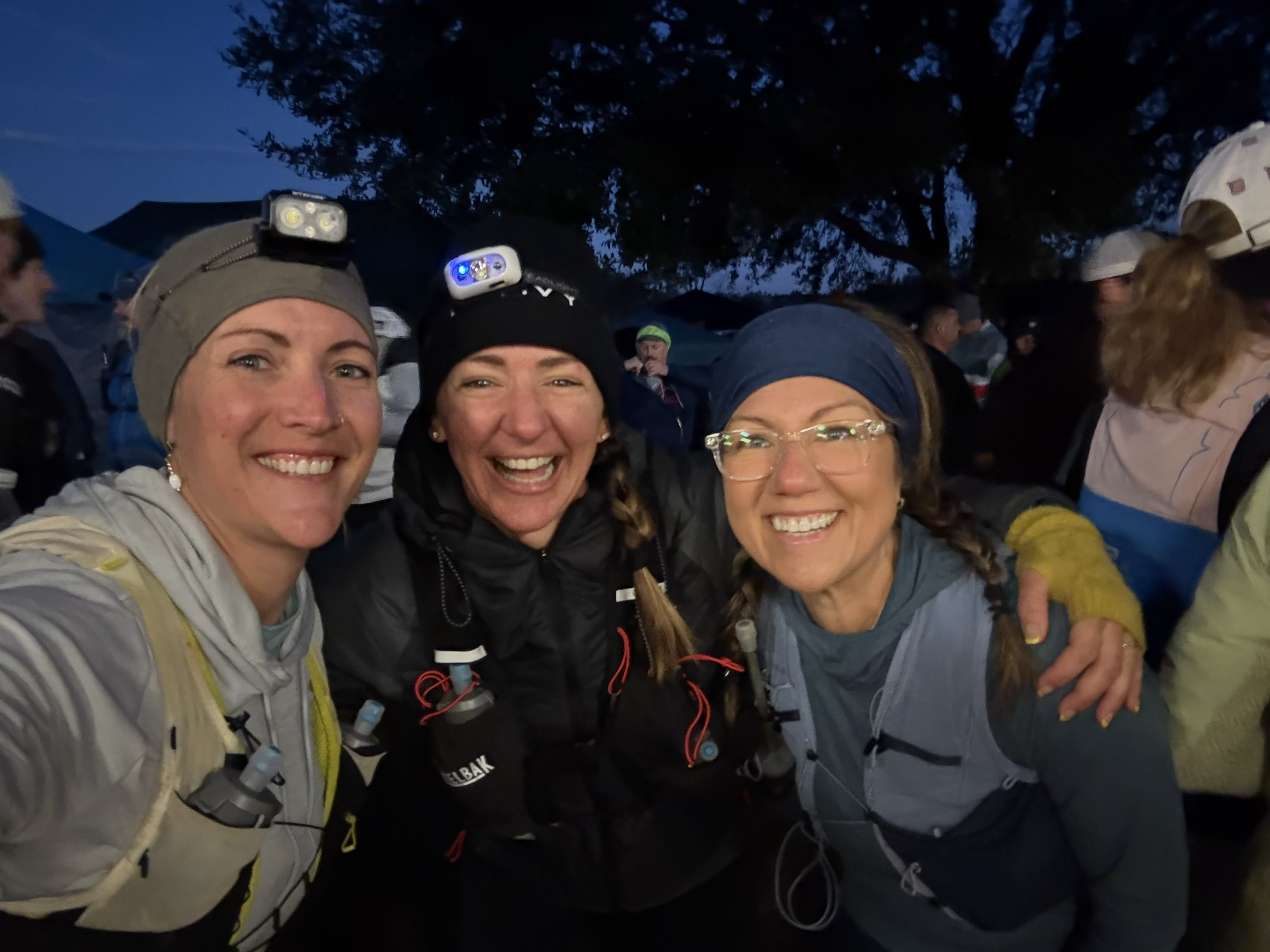
Left to right: Mary, Sally, Majel
Watch Sally’s race video — Mary and I make a quick cameo from this photo moment. https://youtu.be/ItOJVLmz8So?si=1Wxyj7Mr4cLSFdAu
When It Unraveled
The 71 miles I covered turned into a long day of grinding without a clear why. Things unraveled even though I kept forcing myself forward.
The mistakes were small at first. Then they stacked up.
I did not bring the right overnight clothes.
I accidentally took Tylenol PM at mile 60.
I did not have a real contingency plan for when things went sideways, because I assumed flat meant easy.
But flat is not easy.
Flat means continuous running. The same muscle groups, over and over. No terrain variation to give your legs relief. The Florida sun was a different stress than an Indiana winter — heat during the day, then a sharp drop once it disappeared.
I run well in heat. But I did not prepare for what came after.
When night fell and the temperature dropped, I did not have what I needed to get dry, layer up, and reset. Then the Tylenol PM slowed me down. I tried to nap. My body temperature crashed. I started slipping toward hypothermia, and along with the cold came confusion.
Not tired confusion. Decision-making confusion.
The kind where options technically exist, but you cannot access them.
It is easy to list the solutions afterward, warm and rested.
But none of that happened.
I dropped.
And I think that is what stings most. I did not just lose the body battle. I lost the story. I never fully committed to the finish line, so when things got hard, I did not have anything sturdy to stand on.
The Loneliest Miles
When you are out there long enough, the mind wanders to places you do not visit often.
How do I eat? Drink? Rest?
What do you need to survive longer?
What is really important to you?
What do you need to let go of?
There is a lot of time out there for the truth to catch up with you.
If you show up half-baked in life, it will show up in your race.
That is why I love this distance. It is a brutal kind of honesty. Time becomes your superpower, and your body becomes the megaphone for whatever your mind has been avoiding. You do not get to outrun it.
You get humbled by the effort.
Humbled by the volunteers.
Humbled by the other runners. Everyone is carrying something.
We are all just humans doing our best. Making promises in weak moments to do better. To be better. To try again.
This Was My Race
Deeply humbled.
Grateful for the chance to learn.
Quieted by my ego.
Reminded to plan better.
Respect the distance.
Respect myself enough to show up prepared and invested.
The hundred will always cost you something. We know that going in.
But it will also give something back — if you go far enough, and stay present enough, to hear what it is trying to teach you.
And I will toe the line again.
Not for the beach.
Not for proximity to greatness.
For the work. Because when I respect the work, I earn a finish line I can agree with.