Finding Out What Is Possible in a Backyard Ultra
Six years after first experiencing the backyard ultra format during the pandemic, I finally stood on the starting line of a true live backyard ultra, and it turned into one of the most meaningful race experiences I’ve ever had.
Back in 2020, I ran the Quarantine Backyard Ultra out of my home alongside thousands of runners around the world. Everyone checked in after each 4.167-mile loop from their computers as we all tried to stay connected during the height of COVID. At the time, all the races I had trained for were canceled, group runs disappeared overnight, and the running community suddenly felt very far away.
Instead of letting the training go to waste, I turned the event into a fundraiser for our local United Way COVID relief fund. I checked in after every loop on Facebook Live, entertained my running friends throughout the day, and somehow convinced people to donate while watching me slowly unravel lap after lap in my neighborhood. We ended up raising $1,214.00 and I ran 17 yards (70.839 miles). Looking back, it was one of the purest reminders of what running communities can do for each other when things get hard.
That virtual event was my introduction to the backyard ultra format.

All packed for Grind…“Bib” sticker on tote Tim printed me for the Quarantine Backyard Ultra.
For anyone unfamiliar, the backyard ultra was created by Gary Cantrell, better known as Lazarus Lake, the same mind behind the infamous Barkley Marathons. The concept is brilliantly simple and absolutely ruthless.
Runners complete one “yard,” which is exactly 4.167 miles (6.706 kilometers), every hour on the hour. That specific distance matters because if you complete one yard every hour for 24 hours, you end up with exactly 100 miles. Finish the loop in under an hour, and whatever time you have left becomes your recovery time before the next start. Finish too late, or fail to make it back into the starting corral for the next hour, and you’re out.
Then everyone does it again.
And again.
Until only one runner remains.
There are no set finish distances. No guaranteed finish times. No hiding in the middle of the pack. The race keeps going until there is one last person capable of completing another yard alone.

That final successful loop is called “The Assist” for the second-place runner, because their final completed yard enables the winner to continue one more loop and officially become the Last Person Standing.
It sounds manageable at first because the pace requirement averages out to roughly a 14:24 mile pace if you move continuously. But the challenge is everything else that happens inside that hour: eating, hydrating, changing clothes, bathroom breaks, stretching, shoe swaps, weather adjustments, mental resets, and eventually even trying to squeeze in tiny naps. Backyard ultras aren’t really about speed. They’re about problem solving, patience, and slowly surviving your own decisions longer than everyone else.
I’m not new to looped courses. Over the years I’ve done well at the Hawthorn Half Day Relay and Ultra in the 12 hour solo division (shameless plug since I now own the race), which uses a 3.1 mile loop format. That race is time based rather than elimination based, but I’ve learned something important about myself through those events: I actually like loops.
I think it’s because every loop becomes its own manageable task. Run a solid loop. Earn a quick reset. Grab a reward. See your people. Repeat.
There’s also something motivating about constantly seeing other runners instead of disappearing alone into the woods for hours (which I love equally). Backyard ultras especially create this weird little moving community where everyone is simultaneously competing against and supporting each other all day long.
Another advantage of the format is access to your own aid station every single hour. In many ultras you’re relying mostly on aid stations and carefully planned drop bags. In a backyard ultra, your entire race headquarters is sitting right there waiting for you every loop. That means you can constantly adjust, and those adjustments are often what determine how long you stay alive in the race.
This year I decided I wanted to experience a true backyard ultra in person, and I signed up for Grind on the Grid Backyard Ultra.
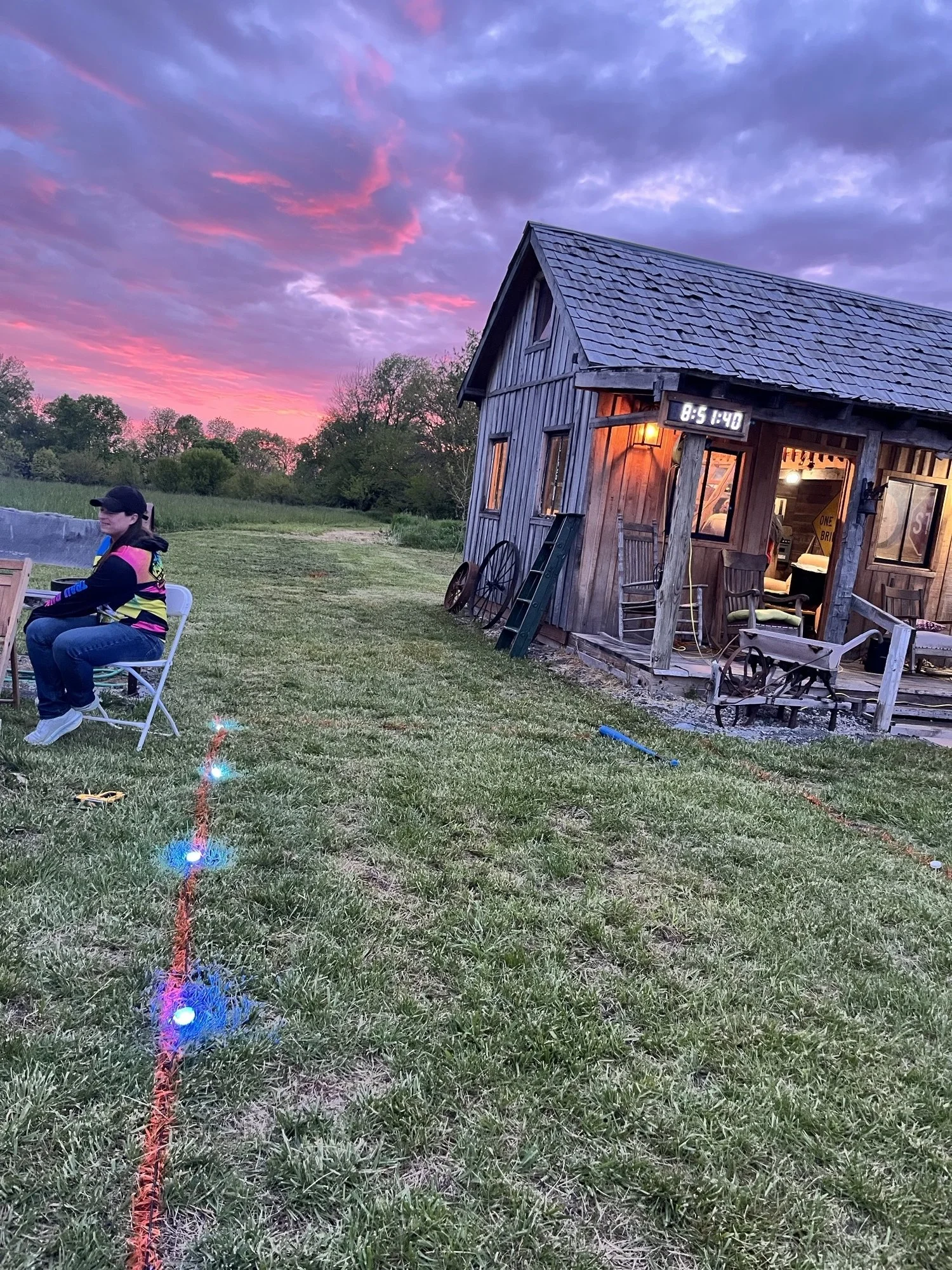

I’d always wanted this race to be my first real backyard. It’s a little over an hour from home, intentionally small, and put on by people who genuinely care about the experience. Small ultras are getting harder and harder to find as the sport grows, and this one still had that grassroots feel I love.
Also, the race director's mom makes a handmade quilt for the Last Person Standing.
And honestly?
I really wanted the quilt.
My strategy going into the race was to intentionally use most of each hour instead of banking huge amounts of recovery time early. My friend Hannah came to crew for the weekend, which turned out to be one of the smartest decisions of the race. Earlier in the week we met to plan race strategy, nutrition, pacing, and how we wanted our little headquarters set up.
We decided to target roughly 52 minute loops for the first 12 hours, then allow a little more time overnight as fatigue built. Most loops ended up landing consistently between 50 and 53 minutes, with a few slightly slower overnight loops later in the race. The course itself became much tougher over time than I expected.
It started through a wide grassy field alongside cornfields — or maybe beans this year — with uneven footing almost the entire way. There weren’t many long smooth sections, so you were constantly weaving around ruts and searching for stable ground. That section lasted for over a mile before we popped out onto a gently rolling gravel country road leading to the turnaround.
The turnaround section became one of the most psychologically interesting parts of the course because you could finally see the spread of runners ahead and behind you. Every hour you’d quietly assess who still looked smooth, who was struggling, and who seemed way too comfortable for the mileage everyone was stacking up.
Around mile 2.5, the course shifted onto a paved country road leading back toward camp. Near mile 3.8 we’d pass our tents, where I could always count on seeing Hannah cheering and waiting to check in with what I might be needing next. Then came one final rough section back into the property alongside a cornfield where the tire-rutted path became so uneven it honestly felt easier just to run in the corn itself before returning to the start/finish area.
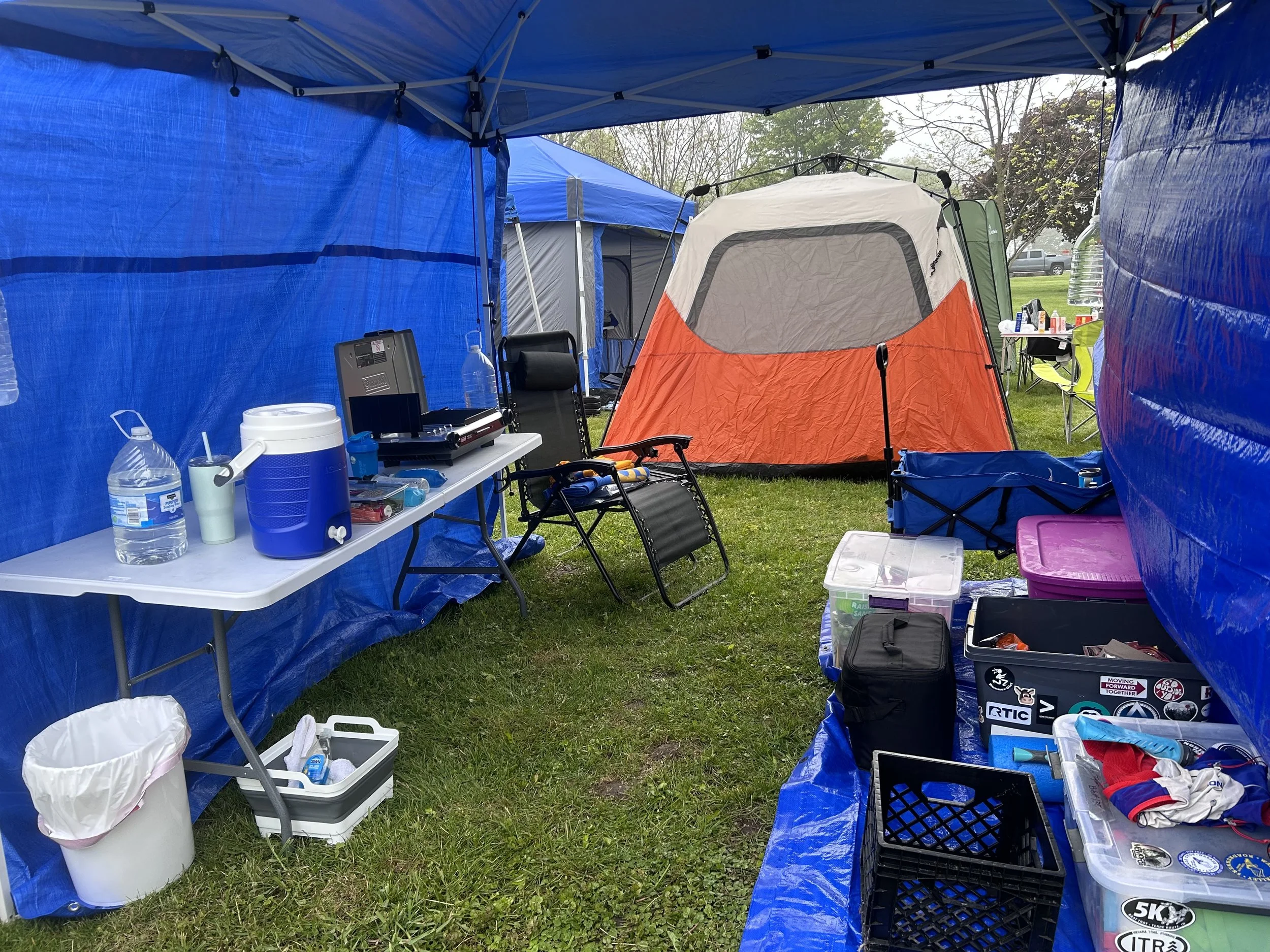
We set our tents directly near the corral, and I quickly realized how precious those few recovery minutes really were.
Even early in the race, I was using nearly the entire 10-minute recovery window every single loop. Refueling. Changing layers. Discussing strategy with Hannah. Mentally resetting. It felt rushed immediately, which surprised me.
Meanwhile Hannah had our camp running like a military operation.
She brought a camp stove and cooked throughout the entire race. Sausage. Bacon. Potatoes mixed with ground beef. Grilled cheese. Ramen. Every loop I’d come in and food would already be waiting. I didn’t have to think. I just had to eat.
More importantly, she tracked everything.
Every calorie. Every electrolyte. Every serving of Skratch Super High Carb. Every Ketone IQ. She reminded me when I needed more sodium, more fuel, or more fluids, and she kept me accountable to the caffeine and sugar limits we’d discussed before the race.


It’s funny how quickly your brain starts failing in backyard ultras. Even simple decisions suddenly feel overwhelming when the clock is constantly counting down toward another start. Hannah never let the chaos take over. She brought exactly the level of structure and discipline I needed to keep moving efficiently.
Around the 12-hour mark, the race changed.
At first I’d been intentionally holding back to protect my legs. By then, I realized I wasn’t “slowing down strategically” anymore — that had simply become my actual pace.
We dealt with relentless winds throughout the day, with gusts reaching around 24 mph across the exposed farm sections. Fighting those winds hour after hour drained energy faster than I realized. But Hannah kept updating me that conditions were supposed to calm overnight, and for maybe the first time ever in an ultra, I found myself genuinely excited for nighttime to arrive.
She was right.
As darkness settled in, the winds finally died down, and mentally that felt enormous. I no longer had to battle both the course and the weather simultaneously.
Then Mary arrived.
Mary showed up around the 12-hour mark, and I cannot overstate how much of a boost that gave me. We've spent over a decade racing ultras together, and she understands endurance racing and honestly me at a level very few people do.
She took over the overnight crew shift so Hannah could finally rest, and she brought coffee.
At that point, seeing Mary with coffee felt like a religious experience.
Mary immediately stepped into full ultra crew mode. Every loop she made sure I ate, even when I didn’t want to. She helped me swap wet clothes to stay warm, reminded me to use the bathroom while I still had easy access to porta-potties, changed shoes and socks, and continued the fueling structure Hannah and I had established all day.
Then she’d shove me right back into the darkness for another yard.

Our fueling strategy was one of the things I’m proudest of from this race because it stayed surprisingly controlled for such a long effort.
The plan was zero caffeine until nighttime. During the day I focused primarily on protein, electrolytes (LMNT and coconut water), Skratch Super High Carb drink mix, and Ketone IQ for energy without caffeine. I intentionally kept sugar intake fairly low early on.
Overnight I maintained the same structure but replaced some Ketone IQ servings with small amounts of coffee when needed.
Around mile 60 I took my first dose of Tylenol, then one more later around mile 84.
When I crossed the 100-mile mark — which also happened to line up with the start of a new day — I mentally reframed the race. I needed to feel like I was beginning an entirely new event, just with exhausted legs.
To create that reset, I intentionally shifted my fueling briefly toward quicker sugar sources like GU Roctane and cookies before transitioning back into the previous day’s steadier nutrition approach.
Those loops actually felt pretty good, but I could tell things were changing. I needed to walk more strategically to preserve my legs and feet, and that becomes increasingly difficult in backyard ultras because more walking means less recovery time at camp.
My race ended after 26 yards — roughly 108.3 miles.
By then I was dealing with some upper GI inflammation unrelated to the race itself, and the pain reached a point where I wasn’t comfortable continuing through it. I was also simply tired.
Very tired.
At that stage we were down to three runners: myself, Josh, and Abe.
Josh looked strong literally all day long. Since he stayed ahead of me most loops, I’d see him at every turnaround still moving smoothly and confidently. Abe, meanwhile, had locked into this incredibly steady rhythm that looked like he could sustain forever.
I knew if I continued, this race was likely going several more yards.
Part of me desperately wanted to keep fighting. It had become Mother’s Day by the time Sunday morning arrived, and I really wanted to take the win for the women out there cheering. And I wanted the quilt. I wanted to keep proving something.
But I also knew it was time.
After yard 26, I looked at Hannah and said, "I'm not sure what this pain is in my back, but I'm worried about moving forward with it and making it worse. Also, look at those guys. This is going to be a fight that I'm emotionally ready for, but I think this is my sign. I need to check in with this and listen to my body."
Listening to your body sounds simple, but it becomes incredibly hard after you've already spent more than a day pushing through some pretty significant painful moments.
Earlier in the race Hannah had made a sign with a checklist of reminders to keep me moving and keep my head in the right place. One of the most important things written on it was:
"Don't quit in the chair."

And I didn't.
With Hannah by my side, knowing this might be it — but probably hoping I'd change my mind — I stood up and made my way toward the starting corral one last time. I gave one final strong walk toward the line, looked my competitors in the eyes, and headed out with them for a few short strides before wishing them the best and turning back toward camp to take my official exit from the race.
Hannah walked me back toward the tent, and I could feel myself getting close to breaking down. But instead, I realized I was actually pretty happy with what we had done as a team, and that's what I wanted us to remember in the end.
And honestly, one of the strangest and most beautiful parts of backyard ultras is how deeply connected you become to the people you're competing against and with your crew.
There’s a lot of ego in racing. Even the kindest ultrarunners show up with big goals, high expectations, and the same desire to win. We all toe the line believing in what could be possible on a perfect day.
But backyard ultras do something different to people.
When you stand beside the same runners every single hour, sharing the same exhaustion, uncertainty, pain, weather, darkness, and tiny victories for an entire day and night, something shifts. You stop racing against strangers and start surviving alongside them. Everyone out there is fighting some version of themselves.
And the longer the race goes, the more you realize that we all show up on race day with the highest expectations for ourselves, but ultimately leave with what is possible for us that day. At the end of it, I think what most of us really want is to look back knowing we gave ourselves, and the people crewing and supporting us, the best we had to give.

My Girls <3 Mary & Hannah
Somewhere along the way, you start cheering for each other.
That's the part that feels so human.
In the hardest and most painful moments, you desperately want relief from the suffering. But at the exact same time, you also want to keep going because you become invested in watching everyone else's race unfold too. You want to see who figures it out. Who hangs on. Who surprises themselves. Who breaks through something they didn't think they could.
It's the strangest feeling.
You still have to run every mile yourself, but the support, kindness, and shared suffering carry you farther than you thought possible.
I finished the race after 26 yards, covering just over 108 miles, placing third overall and setting the women's course record on the new course configuration.
Somewhere out there over those miles, I was reminded that what I found in ultra running over a decade ago still exists inside me:
The need to find out what is possible.
I think I found something that fits my running style and abilities in a way I did not expect, and I'm pretty excited for the next challenge and to see how far I can go in the backyard ultra format.
What took me so long?